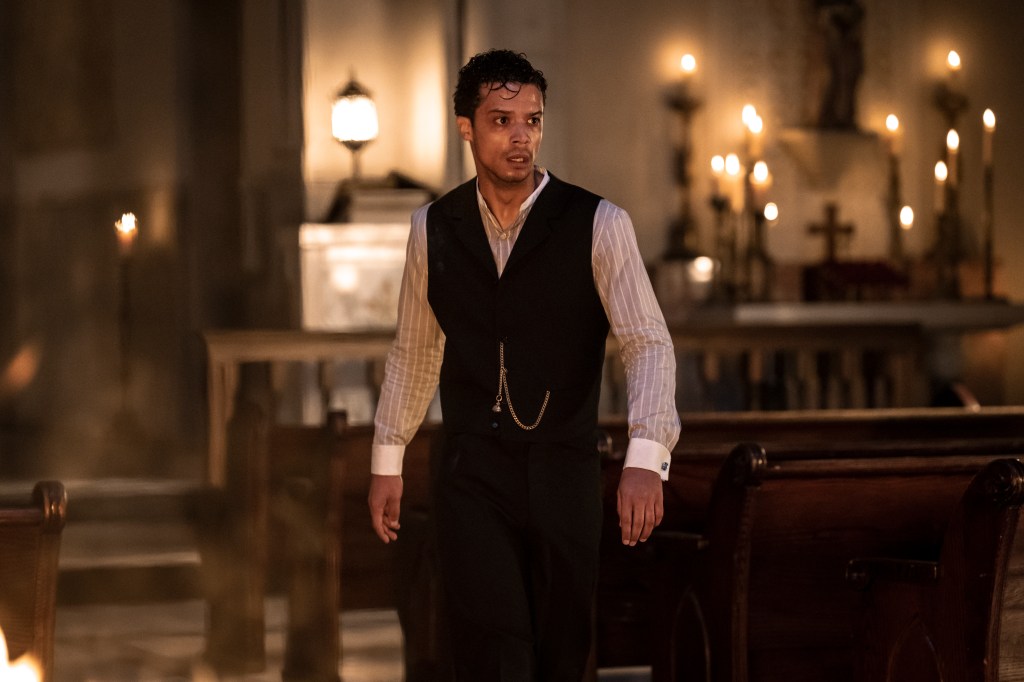

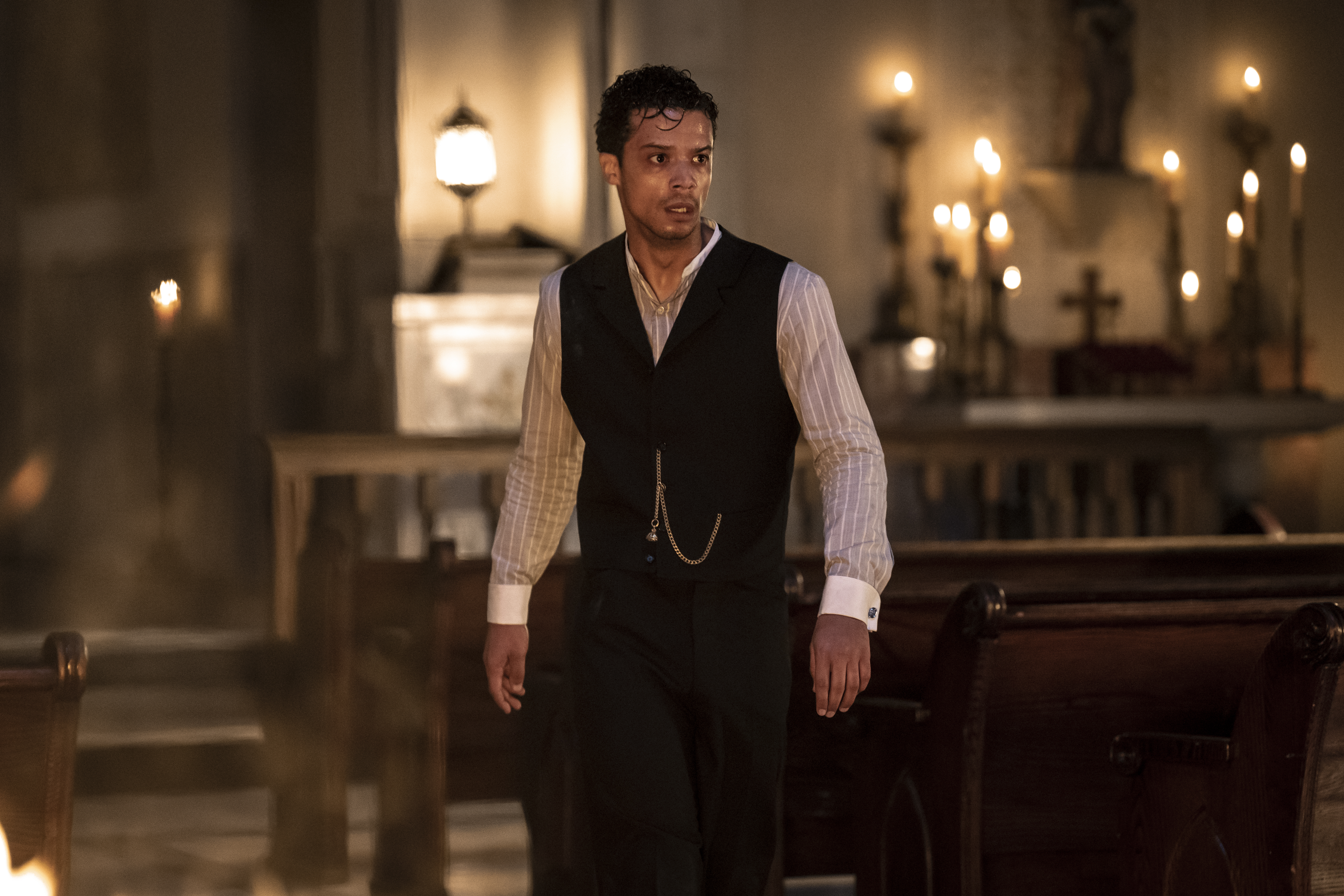
Louis de Pointe du Lac (Jacob Anderson) manages pre-wedding jitters. Photo Credit: Alfonso Bresciani/AMC
Louis de Pointe du Lac’s “odyssey of recollection” will span decades, world wars, at least three accents and almost as many husbands, but one constant, no matter the persona or partner or continent, will be our hero’s love of books. If you’re courting him, let him stock your shelves. If he’s depressed, he needs stacks of them spilling around him. If you need something, like his forgiveness, gift him one that’s ancient and rare. It always circles back to stories with Louis, and he wants to try his hand at his own again.
There was a first attempt, with a young journalist in a gay bar hunting only for leads. It was an unmitigated disaster: the journalist, Daniel Molloy, deemed unworthy, Louis not understanding his own story, attempted murder; we don’t know much beyond that, and their reunion doesn’t give many clues. They barely establish ground rules before they embark on their second attempt, diving into Louis’s background in New Orleans. You would think Daniel had already heard it, if the first interview followed Anne Rice’s book, as the few tape excerpts suggest. You’d also think he knew Louis had a daughter, if they came to their first bloody end when she runs away. He has heard about Louis’s partner, Lestat, though now he’s getting a more “nuanced” portrait, as nuanced as dropping someone from 1,000 feet can be. He will also, finally, be introduced to this daughter, Claudia, and learn how she saved Louis’s life.
The reasons for the second interview, like the contents of the first, remain elusive. Aside from Claudia, the conceit that a book would be superior to video or social media when it comes to vampire warnings, and Geopolitics, one of the only explanations Louis will provide is: he’s “changed.” Louis is, in fact, on at least the third version of himself. This one is good. Better than other vampires, a master of his instincts and control, except for when he’s making dinner into a weird power display for Daniel.
The Louis we meet when he takes us back to New Orleans, is, in contrast, a much “rougher thing:” clothes with actual style, a natural accent and occasionally abrasive personality, one Louis is quick to assure us was only a front he maintained for the good of his family. To a Daniel who doesn’t seem like he’s heard any of this before, Louis recounts the way he saved the de Pointe du Lacs from bankruptcy, acting as operator of a “diversified portfolio of enterprises,” and if that portfolio included pimping, it was beyond his control and inclinations; neither was threatening his brother; neither was becoming a vampire. It was for the good of the family, it was his duty as “favored son,” it was all an act; he was “hunted,” rushed through the process, ambushed, he never got a moment to think, he’s in my head, his words, his voice—
That voice is going to swallow Louis up and spit him out a shell of his former self. Only through Claudia’s strength and guidance will Louis exercise his will again, when it most counts: killing Lestat and freeing them both to race off to a new, happy life.
Until Daniel shatters that narrative.
For all these claims of enlightenment, Louis doesn’t seem to have considered that Daniel may have changed as well, as a person and a journalist. Or he doesn’t take it seriously, because Daniel more than warns him: “I’m not your fucking boy.” Daniel has come with multiple Pulitzers and a red pen, and refuses to be the idiot listening to another fever dream, especially when Louis hasn’t even been careful. Missing pages and muted conversations, conflicting visuals and timelines, a secretary guarding it all with the subtlety of an elephant on a cat—you don’t need Daniel’s Masterclass to realize the second interview is as unreliable as the first.
He shatters another narrative, too: after seven sessions, Daniel doesn’t think Louis has changed at all. Despite this new veneer of respectability and honesty, this third persona, he is still Louis the pimp, in dire need of someone to talk to, another story to tell himself.
If there remains any question about the veracity of Louis’s account, or our own internalized DARVO in exploring it, the reveal that this secretary is Armand, an ancient vampire whose powers include visions and flight, puts that to rest. If there remains any question about that:
“Memory is a very huge, huge part of this show. The tagline for this show should be ‘Memory is a monster.’ We’re only on episode 7 of 15. You only know half of it, maybe.”
The question is no longer if Louis is a reliable narrator, but why he isn’t. Who or what is he actually running from? Why did his story have to change? Why did he have to change? Which version of his daughter, partner and most importantly himself is real?
Why is his library floating 50 feet in the air, when he isn’t the one who can fly?
Immobilization and emasculation
The “rough” version of Louis in 1910 seems content enough, if not necessarily happy. His family has struggles—they nearly went bankrupt, and Louis’s brother Paul is severely mentally ill—but any strife, like Louis drawing a knife on that mentally ill brother, can be resolved over a lighthearted breakfast. His girls love him, even as he brushes off their attempted rapes. He is gay, but it’s easily repressed, and the prostitute he hires as beard is more like a friend, and more than happy to keep his sexuality a secret.
All that changes when he walks into the Fairplay one evening, and somebody else has hired Miss Lily. Louis greets the stranger with a challenge, the stranger sends one back, and it hooks Louis as hard and completely as falling under a spell. He finds himself unable to move or act, his body “seized with weakness,” the stranger’s gaze like a string cinching his lungs. Everything around the two of them falls away to hazy backgrounds and close-ups as the stranger croons the moment that hooked him: When I watched a man pull a knife out of his walking stick and pressed the blade to his brother’s breast bone. Louis can’t even begin to breathe until he looks away.
It’s interesting that what Louis loves about the stranger, who is of course Lestat de Lioncourt, is the challenge, confidence and dominance to match his own, yet the way he portrays the scene—immobilization, enchantment, hypnosis, helplessness—is evocative of a phrase we’ll hear in variations throughout the season: Lestat had a way about him. It was nothing to do with Louis himself.
Nor the ensuing whirlwind . . . something. Shopping, opera, deep conversations we aren’t permitted to hear: “He was in love with my city,” according to Louis; “not a city but a handsome man, with a most agreeable disposition,” according to Lestat. The discrepancy is easy to explain. It’s only in hindsight that Louis has been able to realize nothing in their courtship was real or romantic; rather “hunting,” seduction, the start of a harrowing cycle of abuse that will continue for decades, tear their family apart and leave himself and their daughter with no other option but to murder Lestat to escape.
“Love?” He’ll scoff at the very suggestion in 1.07.
Of course, Daniel dismantling this narrative complicates things a bit, as does Louis keeping their deep conversations from us. Even if we ignore the revelations of the finale, it’s hard to judge the courtship, or lack thereof, when we don’t even know what their dates were like.
Is Louis simply editing, like any good author; skipping over boring or unnecessary filler? Do we need anything more than what we do have: the timeline? At the start of the episode Grace lets us know she’s getting married in a month (during the “fall of the fifth year”) and her wedding closes it. Proposing eternity together after 31 days isn’t healthy or good by any measure. No conversations needed.
Still, it’s a strange choice for a storyteller to make, as Louis’s turning will hinge upon the content of these conversations, the closeness he never felt with “anyone, much less a man,” and it won’t be the only time he’ll mute pivotal conversations, as we’ll see later in this very session.
It also wasn’t only a month.
That “fall of the fifth year” turns into a “cold winter,” and then it’s spring when Grace gets married—and May 1911 on Paul’s tombstone a few days later, which shows it was actually nearly summer when Louis turned. What was in reality at least three seasons and six months, reduced to a jumbled timeline and a few minutes of montage, conveyed more like a whirlwind romance than half a year of dating.
Another thing worth noting is the dichotomy between some of Louis’s words and visuals. He was “hunted,” over a shot of Lestat looking hungry and longing, but also vulnerable, and a little in awe. A similar example will occur in the next session.
Louis is “being hunted,” but maybe not for the reasons he thinks. We know from comments throughout the season that Louis isn’t Lestat’s first love—that was Nicolas, a man he grew up with in France. If Nicki’s story stays close to the books, we know the broad strokes of what will happen after Lestat turns: Nicolas begs to be turned as well, and though Lestat senses he doesn’t have the disposition for vampirism—it requires a certain temperament; “What we’re doing is hard,” he tells Louis—he obliges anyway. It ends in madness, torture and death for Nicki. Lestat was so traumatized it’s taken him 100 years to even begin to search for another companion, and he needs to make sure he chooses right this time—someone with the temperament to survive decades and centuries together.
What Lestat was seeking, in other words, was Louis’s true self. The way he scraps and provides for his family, similar to Lestat’s role in his family. How an opera can move him to tears, despite his dismissive facade. The passion that drives him up a river at mach speed to kick his partner’s mistress out of her house so he can fuck him in it.
So how can we determine if Lestat is right? Louis is in Dubai swearing he’s changed and happy with “the love of his life.” Did Lestat correctly see Louis’s “true self?” Who is that true self? Why might Louis dislike him so?
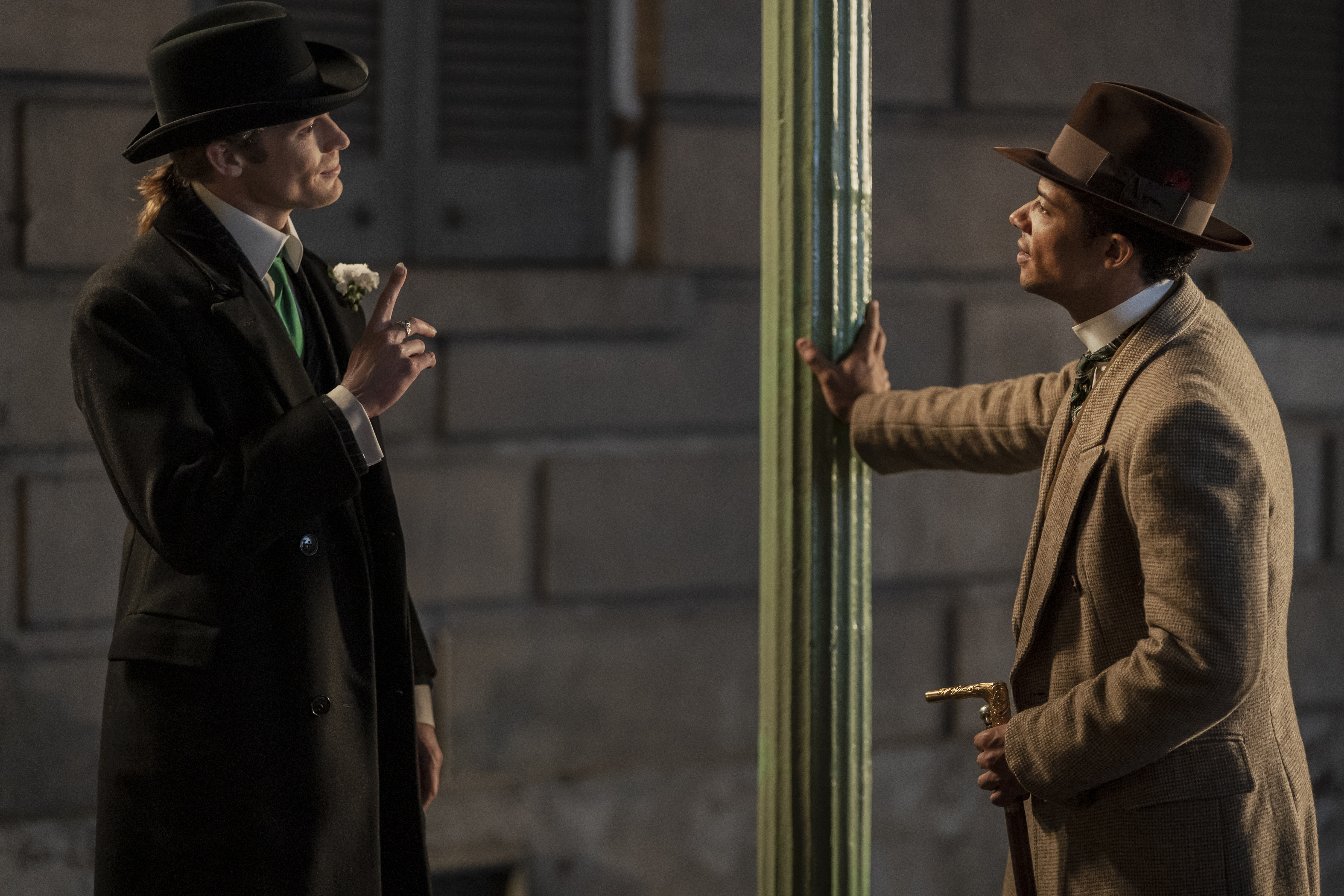
6 ft? 6 ft 1? Sam Reid as Lestat de Lioncourt and Jacob Anderson as Louis de Pointe du Lac. Photo Credit: Alfonso Bresciani/AMC
To the rings of Saturn and back
As Lestat says, Louis is forced to perform many roles to slake the demands of a racist, homophobic society. He needs to appear tough on the streets of Storyville yet deferential as soon as he enters the saloons of the city’s white elite. He’s expected to placate these men with “sir” and accept their insulting job offers, even when he knows he’s the smartest one in the room. He’s a regular at the local brothel . . . for conversation. With his family he needs to pretend he isn’t doing any of this, as they share his penchant for denial: “This is just a temporary situation until Louis can find us a more respectable business.”
Lestat is astute in his observation that these paradoxes, this pressure to succeed under almost impossible circumstances, are tearing Louis apart, and causing him no small amount of self-loathing. Colorless clothes, no accent, suppressed emotion: the way everything about him in Dubai is the direct opposite of who he was in New Orleans is by design, not coincidence. Louis wants to get away from that former self.
It brings us back to this essay’s opening questions, namely: why did he have to change? Did Louis need to distance himself from the victim in Lestat’s townhouse? The man who needed his daughter to save him? Any misplaced guilt he may feel over Claudia’s eventual death?
Maybe, but Louis was hating himself way before any of that, as we’ll see a little later in a Church confessional. One of the biggest causes of his self-loathing is his sexuality. His mother and sister seem to tolerate it, sort of, as long as there’s plausible deniability and he keeps funding their elegant lifestyle, though it’s telling Louis feels they “talk behind my back like Paul does to my face.” He wasn’t even able to label himself gay until some point after Lestat; “obviously I’ve fully accepted myself now,” he assures Daniel, as the man he’s lived with for almost a century poses as his servant and doesn’t merit eye contact. The fact that he currently lives in a country in which homosexuality is not legal is almost too obvious to mention.
Drunken fumblings are what Louis describes his past experiences as; nothing like when he met Lestat, no dating or long talks and probably no sex, or at least only up to a certain degree. Even when he meets Jonah again “he did me face and I drove him home,” suggesting no reciprocation.
With Lestat, though, it’s slow, six months. Even the night of is carefully arranged, like Louis could spook at any moment: the curtains are closed, the servants sent away. Lily is hired as bait, and alibi; everything about the night is designed around Louis’s comfort. Lestat even waits for Louis to initiate their first kiss, and when Louis finally gives in to his desire, it’s like a surrender.
Imagine a hit of black tar heroin, Louis says, multiplied “by miles, to the rings of Saturn and back,” and you’ll start to get an idea of how powerful the experience was . . . though he shows them doing nothing more than exchanging blood, which he apparently never questioned. It’s the start of an unwillingness to show physical intimacy between them; in fact, all versions of Louis want to act like nothing ever happened. It would have been impossible for him to be out as a Black man, he explains in Dubai, and so, despite the “toll” on his body, the “feelings of intimacy” he never felt with another person—despite his life changing, which is how he describes the night—he leaves Lestat’s home on Rue Royale without a backwards glance.
Words, roots, voice
Attention returns “to life as it was before.” The night is “shut out” of Louis’s mind, Lestat doesn’t try to get in contact and Grace’s wedding goes off without a hitch. There’s an extended tap dancing sequence, to show how sweet life is when you ignore your gay urges, after which Louis and Paul retreat to the roof to reflect upon the new chapter of Grace’s life.
Paul has been struggling with the change, regarding Levi as nothing more than an interloper. “You think [he] loves her enough?” Paul asks. “You think he’s giving her everything he’s got inside him?” The topic turns to Lestat, whom Paul also dislikes, and only partly due to homophobia. Lestat blew up at him over dinner, invaded his mind and stopped only when Louis intervened.
“He’s here to take souls,” Paul insists, “he’s the devil,” and if we ever doubted Louis’s story before now is the time for irrevocable proof. Paul throws himself off the roof, and after two blissfully silent weeks, the monster hunter Louis warned us about strikes.
All Louis wants is to mourn his brother, and Lestat will not allow it. He ambushes the procession. He invades Louis’s mind during the burial. He leers straight at us. YUM. It’s as though he senses Louis is at his most vulnerable—the perfect time to spring the trap he’s been setting. In fact, the timing is so convenient the implications will haunt Louis for decades. Lestat systemically isolates Louis from his closest friends, the woman he pays to beard and two priests who babysat Paul, and finally corners him in a Church. Louis has no choice but to defend himself, stabbing Lestat with his cane’s knife again and again.
When Lestat stands, however, his coat is pristine. Seconds before Louis had torn cloth and drawn blood. This is the first time we’re encountering altered visuals in Louis’s recollection. A few minutes later there will be another muted conversation. And there’s a lot going on with Louis that deserves our attention, even before Paul killed himself and Lestat broke the fourth wall.
Maybe the funeral to turning pipeline calls for a closer reading.
Leadup
- Louis, deeply repressed, has an intense sexual experience with the man he’s been dating for half a year. It’s the most incredible experience of his life—it may even be the first time he has sex—but he claims he’s able to put it firmly and neatly behind him. It doesn’t impact his life or sense of self either way; it causes him no crisis.
- Grace gets married, and Paul, fearing he’ll be left behind without his siblings—and understanding that Louis wants to be with Lestat—kills himself.
- Louis is blamed. He must have been mean, Florence says, as usual; Paul is in hell because of him. It’s a terrible blow for anyone, but Louis doesn’t show us much of a reaction; or at least it’s not what he’s thinking about at Paul’s funeral, because
The funeral
- He is ambushed.
“An elegant coffin,” Lestat sneers. “Would you tell me where you purchased it?” It doesn’t make a lot of sense to say if Louis doesn’t know he’s a vampire; it does establish Lestat as “discerning predator” to Louis’s vulnerable prey, gives Louis something to focus on beyond Paul, his family’s blame and all the other problems coming to a head this night. “Lestat’s ambush disoriented me,” not his mother refusing to walk home with him; not his own possible suicidal tendencies; not the fact that he had sex with a man two weeks ago and loved it.
(There’s an interesting sequence, after the transformation Louis cannot join. He drifts to Paul’s coffin as though transfixed, and Lestat’s voice seems to snap him out of something. Louis was occupied by similar thoughts during the procession before Lestat crashed it: “the satin-lined evidence of [my] failure.” “What was my life worth?”)
- Louis skips Paul’s wake to “grieve alone,” yet what we see is him stumbling into the Fairplay: he was so upset by Florence’s blame he got drunk. We have no time to unpack this as he immediately discovers Lestat killed Lily, which is what drives him to
The Church
- Though Lestat stalked Louis at his brother’s funeral and just killed Louis’s only friend, this is not what Louis wants to share. “Help me, please! He’s in my head, Father!” It’s his constant refrain: “I can’t think of nothing else,” “his voice and his words,” his “roots in me, all his spindly roots in me.”
-
(It tbh sounds more gay to us than anything. It sounds like: I fucked him and I can’t stop thinking about him.)
- Louis confesses all his personal failings: he’s a liar and a cheat. Exploiting people comes easy; lure them in and grab what they got, just like what’s happening to him now. He failed his brother, lost his mother and sister and rather than face his issues he runs, and amidst all these mistakes one thing, saved for last, breaks his voice: “I laid down with a man. . . . I am weak! I want to die!” Lestat bursts in.
Though Louis only mentions suicide once, at the end, almost throwaway and drowned out, everything Lestat does is centered around it. “I can give you death,” he proclaims, the one Louis has “begged [his] feeble, blind, degenerate, nonexistent god for;” he swears to take away Louis’s “voluminous sorrow” as well. He claws at Louis’s shirt, practically into his lap, like he has to keep Louis close.
More evidence of his controlling nature? Perhaps. Maybe it’s as big a red flag as I love you after six months. But it’s striking how everything about Lestat screams desperate, like he needs to keep Louis from doing something.
What would Louis be doing? Would an ambush really have driven him to it? Would it have driven him to confess all his life’s failings, the secret things he hates about himself?
Does the Church sequence not make more sense as the culmination of a personal crisis that began when he consummated his relationship with Lestat, and exploded with Paul’s death?—Does it matter? Are we arguing semantics to let Lestat off the hook? There are hints of suicidal urges throughout the funeral, after all, and Louis explicitly mentions them in the confessional and again at the altar: “Even my guilt and my wish to die seemed utterly unimportant. . . .”
But we don’t see him struggle through anything, not consummating his relationship with Lestat and barely even Paul’s death, because the focus turns onto Lestat chasing him, forcing him into all these situations, rather than any of Louis’s inner turmoil, the choices he might be making, had wanted to make. He’s so wounded by Florence’s cruelty he gets drunk—and narrative focus is immediately yanked from him to Lily. Any time he seems haunted during the funeral, or voices veiled thoughts of guilt or suicide, Lestat swoops in to “distract.” In fact, Louis’s second explicit death wish is admitted only to drown out something else, even more unbearable for us to witness: Lestat’s proposal.
And it is a proposal; even Louis can’t deny that. They end up at the center of the altar, the flames of Lestat’s destruction nearly candlelight as everything around them falls away, just like their first meeting. Lestat speaks of the home they’ve been building, the flow of love between them, an end to Louis’s shame and personas—deferential businessman, stern landlord, loyal son, “none of them your true nature.” The way he focused on a death wish before his entire speech is centered around the concept of Louis’s “true nature” now, promising to free him from everything that holds him back. He need only accept Lestat’s gift—and there is, strangely, no question between them of what that gift is.
“For the first time in my life,” Louis tells us, “I was seen.”
There is more to Lestat’s proposal we don’t get to hear, beyond one particular request. Louis tries to summarize with a few brisk, businessy words—succinct, efficient—as in the flashback his body trembles at Lestat’s words, whatever is making Louis feel so “seen,” convincing him they should be companions for all eternity. It was an “impenetrable” argument, Louis hedges, as onscreen he seals Lestat’s vows with a kiss, and their hearts sync as one.
Overcome with emotion, Louis ends the session.
Their wedding is the climax of the session and a turning point in the story—no one would know it better than reading buff Louis—so it throws out the argument that he mutes to save time or skip boring stuff. There’s something here Louis doesn’t want us to see, or doesn’t want to relive himself.
It could be the reminder of Lestat’s lies and failures is too painful. Lestat claimed to see his struggles, to see Louis, and offered a gift to escape it all; yet the freedom and understanding Louis was promised will be missing from their life together almost immediately after he turns. It is the main plot of his tale to Daniel: Louis was not suited to vampirism, Lestat was wrong about him, and there is no freedom possible for him as a vampire. Only Claudia, his “light,” can drag him out of the black hole Lestat traps him in.
Once again, we must remember Daniel unraveled this narrative. Louis couldn’t save Claudia a shelf in his heart. He loved and loves Lestat, and he’s still grappling with the same unresolved issues he had as a human, living a life of repression and shame.
With the real plot in mind, why else could Louis be obscuring the events of his turning? Does it matter if we don’t get to see one of the most important moments of his life, his vampiric transformation, the speech that convinced him to turn? Does it matter if he never goes into detail about his suicidal urges the night of Paul’s funeral? That’s a grave issue, not a throwaway line. What would change if the night was guided by Louis’s “wish to die,” rather than an ambush?
This applies to every nebulous timeline, deleted conversation and conflicting visual. Are these gaps and plot holes that will occur over and over (and over) throughout the season natural faults in memory, storytelling, or do they play into the season-long themes of Louis denying his feelings and agency and self?
Finally, and maybe worst of all to Louis: what does it mean when you’re closeted, and your turning was, symbolically, a gay wedding? Your new state of being—the one you won’t be able to bear—is inextricably, forever tied to that?
What does it cost?
Art stages the scene in Louis’s “coffin,” as he refers to the Dubai penthouse, but when it comes to his life the references are literary, and none too subtle. A Doll’s House is attended as he’s trapped in an oppressive, offscreen marriage, inviting his audience to draw their own parallels. Flaubert and Chéri draw our attention to a sudden shift in tone, and a never-heard nickname, at the turning point of the season. The less said about Marriage in Free Society the better. These references serve as clues and markers, shaping his story, guiding his audience, which makes his first one, the opera Iolanta, so interesting. It feels most organic, almost a slip, considering its content. It’s about “a princess who didn’t know she was a princess,” and moved Louis to tears.
Iolanta, who is blind, lives a pampered life in a tower. Her father hopes she’ll never have to realize she’s disabled, but eventually she does learn about sight from a stranger who wanders into her garden. They fall in love, and it’s to save his life that she submits to magic to gain vision. She recoils from the world once she does. Sights are disturbing and the people she thought she knew alien. Her new gift, born of trauma, isn’t a gift at all.
The 19th century attitude towards blindness is outdated, and our discussion purely literary, based on the parallels established in the text. On those terms the link to Louis is obvious, especially as we’ll watch him grapple with his new state of being throughout the rest of the season. Louis received his own “gift” that wasn’t a gift: he was unsuited to it, a failure, “botched,” will spend three mostly miserable decades in New Orleans, lose the only person that made those decades worth it and even now lives like Iolanta, trapped in another tower, symbolically in darkness: surrounded by torn diaries, distorted fragments of the past, feeding another fantasy to a person he pays to listen; ostensibly severed from his favorite hobby, in poor mental health, in a potentially dangerous environment.
. . . Iolanta’s story, however, doesn’t actually end in that tower. Though her early life was one of luxury, it was also extremely isolated and depressing. She was never truly happy (she believed her eyes were “only for crying”) and despite her father’s efforts was cognizant of missing something other people had. And though her sight was gained through terrible circumstances, and the world seemed overwhelming at first, by the final lines of the play she has come to understand and embrace her new life. She abandons “darkness” for “light” and love.
For Iolanta, the trick was understanding her transformation couldn’t only be physical. Two worlds make up creation, her physician tells her, “that of the flesh and that of the spirit.” Until she accepted the two went hand in hand, that “the notion of sight is not just of the flesh,” no real change would be possible, and light would never penetrate her darkness.Be all the beautiful things that you are, Lestat asked as he and Louis knelt at the altar, and be them without apology.
 deep focus