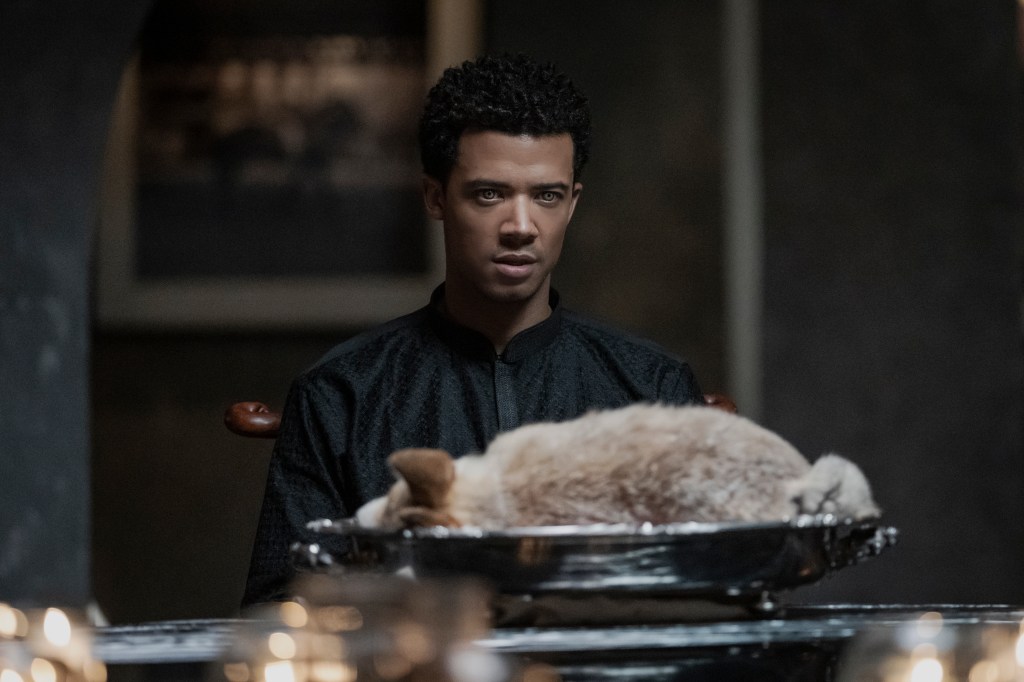

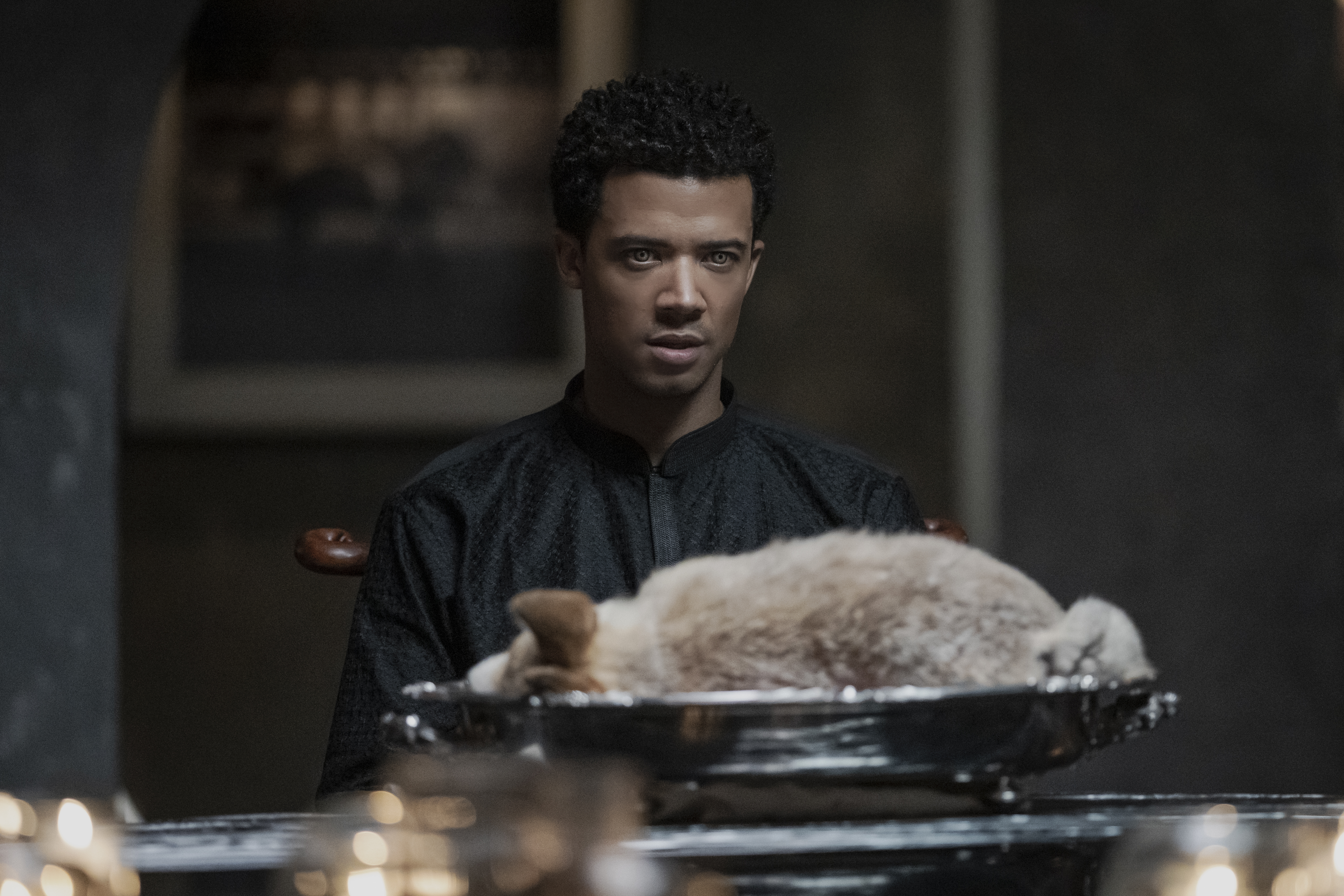
Good hosting is a fine, lost art. Jacob Anderson as Louis de Pointe du Lac. Photo Credit: Alfonso Bresciani/AMC
Louis’s plotting this episode, much like Lestat’s hand in the last, is incomprehensible; to be fair, he’s obviously yet to recover from last session’s meltdown, and to his credit, he gathers himself enough to apologize to his guest. He emerges from the bowels of his penthouse halfway through dinner, a portrait of remorse in his second most shapeless outfit, to music, and assures Daniel that his sickening display of one single tear will never be repeated.
He keeps to his word. The wracked, awestruck, trembling Louis we left sprawled on the altar, much like the Louis who was moved close to tears by the opera, is gone as soon as session two starts, along with any vestiges of a wedding. Lestat strips and swaggers, Louis watches in slowly mounting horror and it feels more like strangers, or some one night stand going wrong, than two hearts just synced as one—sort of the same way Louis wanted to treat their first night.
Incredibly, Louis follows these visuals by telling Daniel: “To satisfy your fixation, being transformed by Lestat, being desired by him, bedding down with him, was an overture of sorts to that side of my nature.” Overture means prologue, “an introduction to something more substantial;” he’ll also contend that “the earth beneath me always felt liquid.” Bold claims to make when we can count on one hand the number of times we’ll see them embrace in almost 30 years.
His “apprenticeship” is a similar letdown. Lestat liked to dangle vampiric knowledge before him like a carrot, Louis suggests, such as the ability to read minds. The scene ends on a strategic “beg,” hoping Daniel’s and our attention will hang on that, and I don’t necessarily dispute it, but it does take me back to the insane unresolved vampire stuff from 1.01, like how a man sank Kangal fangs into Louis’s body and physically pulled blood, and the only issue Louis had was people would gossip. He witnessed Lestat stop time and hold his brother under some kind of hypnosis and said not during dinner. We can read minds? makes me think he’s in my head makes me wonder if telepathy should be such a leap, especially when he’d spend part of their dates grilling Lestat about his “tricks.” In time, Louis. Patience, Louis. Natural fault in memory may blur certain details, as always, but it’s also interesting to consider where these otherwise illogical breadcrumbs could lead; how the story might change if Louis was knowledgeable of vampirism before he turned, and especially if he had any expectations about what it would bring him.
As things stand in the current narrative, it’s all just too much too soon. “He rushed me headlong through the encounter as if it were something to put behind us. Death, rebirth, coming out, homicide . . . too many firsts for one night.” Louis copes by picking up where his human life left off, chasing “phantoms of [his] former self,” which includes accepting Fenwick’s shitty job offer.
This job had been an actual overture to his and Lestat’s relationship, the interaction that cemented Louis’s interest. “Do you not know your value?” Lestat had whispered, as Louis waffled over accepting that paltry 15%; halting time to let Louis know if these men didn’t, he did. “Do you suffer these indignities for some larger purpose?” As of 1.02, Lestat still can’t grasp the larger purpose and can no longer understand the inherent racism in Louis’s new position, no matter how many times Louis tries to explain it to him. When Louis, after a lifetime of tolerance, snaps and kills Fenwick’s racist assistant, Lestat is more concerned with maintaining secrecy than Louis’s wellbeing. He can’t understand why Louis would want to pursue a career at all, especially when there’s already more than enough money for both of them. He dismisses it all as human affairs, useless, pointless endeavors, certainly not what he meant by “swap out this life of shame.”
For Louis, the phrase was always going to mean something very different, centered around ideas of success and power he’d been chasing and unjustly denied his entire life.
The show has to grapple with brutal questions as a result. Can Louis ever truly leave these societal injustices and pressures behind? What happens when a man suddenly gains supernatural power—but is still a Black man in Jim Crow South? Does supernatural power even make a dent?
As previously asked, what happens when he’s queer, and his turning was symbolically marriage to another man, and he was never planning on acknowledging his sexuality to himself, much less coming out? When he can suddenly telepathically hear people commenting on his accessories and clocking his new nails? Could this be another reason Louis clings so hard to his humanity, his “former self?” (Note how he himself identified his turning as his “coming out” earlier in the episode.)
Do his entrepreneurial ambitions also have something to do with chasing that “former self?” Leave those roles, Lestat proposed, businessman, landlord, yet Louis clings harder than ever, to the bitter end, even when he doesn’t really want to, even when they’re demeaning, and even when he claimed to know better.
“I take daughters with no homes and I put them out on the street. . . . Stuffing cotton in my ears so I can’t hear their cries,” he confessed in 1.01, yet the ethics of pimping women have been forgotten as of 1.02. He leverages Lestat’s ignorance and regret into his own saloon where he boasts he “paid the staff better, paid the band better, all the while helping those who had been with me down the block to better themselves.” The fact that we’ll never hear about these people again after the disaster of 1.03 is irrelevant.
Better you
“Loyal son” is another role Louis clings to, to his own detriment. There is a terse meeting with his mother, who hasn’t attempted to see him since Paul’s funeral, followed by a joyful reunion and curious exchange with Grace: “New you,” she says, unalarmed that his eyes have changed color. “Better you.” They swear to never go so long without talking again . . . and Louis promptly ghosts her for five years. This exchange is interesting in light of that fact:
LESTAT: You have to stop seeing them, Louis. They’ll grow fearful of you if they haven’t already.
LOUIS: I can’t do it.
Maybe we can trace the ghosting back to Grace’s strange comment: “New you. Better you.” It doesn’t make a lot of sense, because Grace has no idea Louis has turned . . .
. . . but she does know he’s started living with a man, and it’s one of the only topics they get to cover when they reunite. “Lestat, still?” she manages to ask before Louis interrupts defensively. His demeanor is revealing: he sits at the furthest end of the couch, fists balled, rarely meeting her eyes, like a student summoned to the principal’s office. He even calls her “Ma’am” for the first time, much to Grace’s disgust. Maybe it’s being a vampire, maybe it’s that he’s with a man—whatever it is, Louis is now openly ashamed of himself.
To top the mortification off he may or may not eat her baby, which leads to a turning point in his vampiric life, and another possible explanation why he’s avoided his family. With baby Benny on the floor and Louis weeping on his bed we discover Louis has been suffering feeding issues, apparently this entire time. “I’m never gonna get control over it,” he sniffs to Lestat, who then lets us know Louis has been “skipping meals lately. Don’t think I haven’t noticed.”
It’s news to us, who so far have only heard Louis finds feeding vaguely distasteful and can’t quite get used to the idea. What’s the root of these control issues? What makes blood so irresistible to Louis—is it even the blood? Is it something about the chase that sets him off? What aspect of the hunt, or his desire for blood, is impossible for him to control? Like suicidal ideation, disordered eating is another issue you’d think deserved more than a single line, but we won’t gain much more insight into it this season. Louis laments how he’ll never have his own family, wounding Lestat, and Lestat determines the best way to cheer Louis up is forcing him to pose as his valet to use their opera box seats.
This post-nephew pre-opera scene has always felt a little off to me. The issue is not necessarily one of characterization but execution. From a technical standpoint, the buildup is weird, very back and forth, taking Louis through four emotional shifts in almost as many lines. We had the revelation last episode that he’d loved the opera, so it’s a little jarring that this next mention has him grimacing. He perks up when Lestat admits he’s been “neglecting their romance”—since when was this going on? Why does it suddenly matter, when we haven’t gotten anything else from their home life, and more to the point haven’t seen Louis care about it? Lestat finally brings out matching tuxes, which gets Louis grinning ear to ear—why, when he knows they’re for the valet ruse, which he rightfully hates so much he’s almost shaking in the opera box, and moves away from Lestat?
Louis deploys his mantra to explain: Lestat had that way about him. Moments of charm and occasional thoughtfulness or vulnerability made for a heady, unpredictable, irresistible combination that used to compel Louis to go along with things he hated or knew were wrong, like his humiliation and eventual capitulation at the opera.
These little windows into Lestat weren’t only positive, as we’ll soon see when he brings an innocent if unskilled tenor back to Rue Royale.
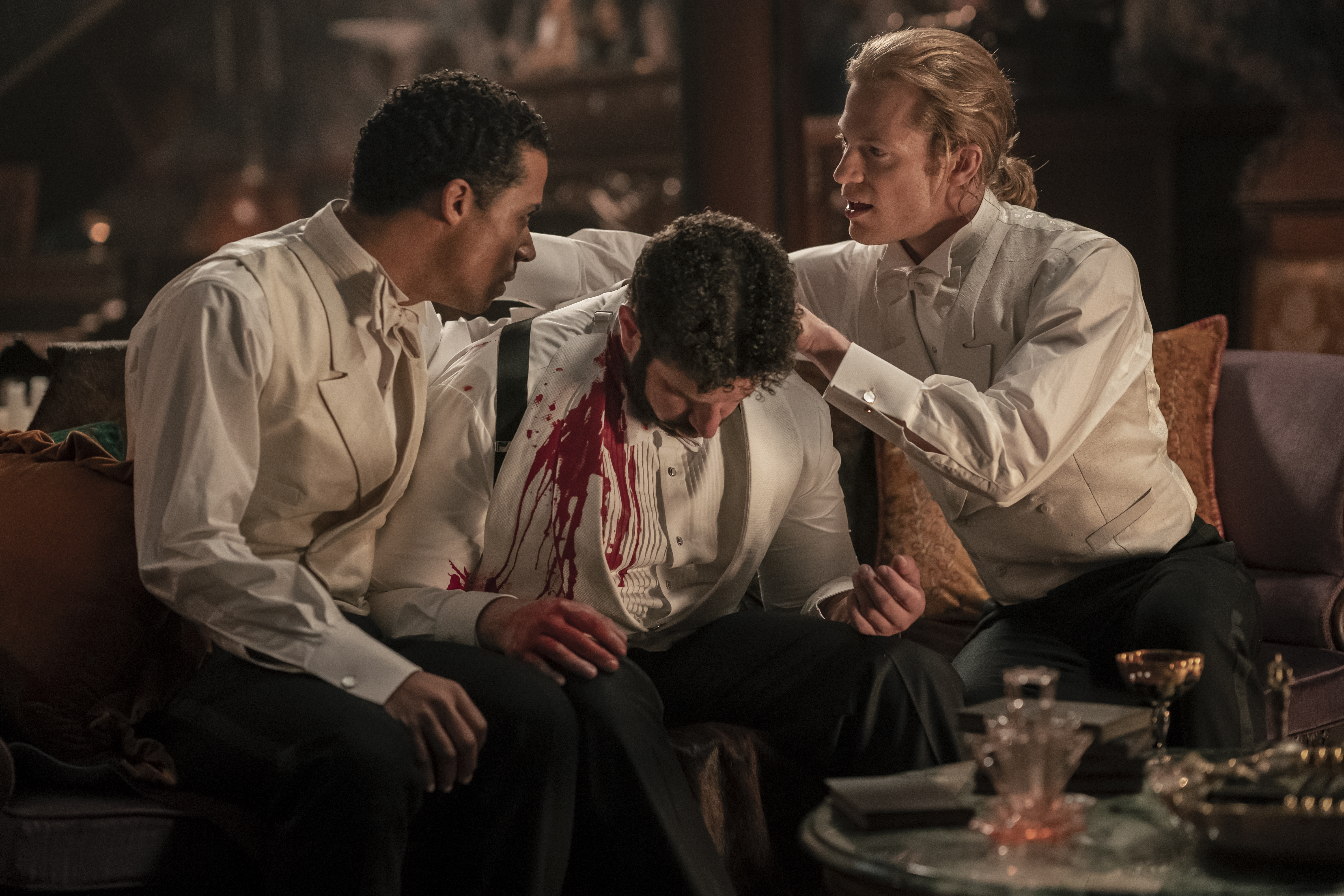
WHAT baby? Anderson with Sam Reid as Lestat de Lioncourt. Credit: Alfonso Bresciani/AMC
Music is to Lestat what literature is to Louis, and so he absorbs each flubbed note like a stab to the heart. He tallies them on his program with lashes of his own blood. He lures the tenor to their house with “fake praise” as Louis watches and wallows in his complicity, and once there manages to destroy “a lifetime of confidence, of joy, in less than half an hour.” Before he goes in for the kill, he pierces the man’s throat, “so no more of your sound can pollute this world.”
Louis can no longer keep silent about what he knows is wrong. “Do you have to humiliate them?!”
Lestat’s rage finds a new target. “Kill them swiftly if you have to,” he bellows, “but do it! Embrace what you are!”
After such a display, “afraid to disappoint,” just like the tenor, Louis has no choice but to join in the murder. Lestat “had a way about him,” Louis repeats for the second of three times. “And I was still very much under his power. We would drain the tenor for hours that night. Lestat completely enthralled. Myself, pretending to be.” It’s an eye-opening experience, shattering whatever illusions remained about Lestat’s true nature, and enabling Louis to understand his own. He’ll never be a “natural,” he realizes, nor “savor the aftertaste. I was a shame-ridden second, a fumbling, despondent killer, a botched vampire.” It’s the first step on his long journey to becoming the “master of [his] instincts” Daniel finds sitting before him in Dubai.
It also ignores the baby screaming on Grace’s floor, who should have been the actual catalyst for this journey. Rather than accept responsibility for that near fatal lack of control, Louis instead suddenly takes issue with the way Lestat kills: drawn out, humiliating, “just like the tractor salesman” Louis didn’t rate above his own coming out.
This account disregards a few other key details we’ve picked up along the way:
- Louis has been skipping meals. He never shows or says this; we learn it from Lestat.
- Though he attacks Fenwick’s man for his racism, he also says, “If not him, would have been the next man. . . . I was hungry.” His feeding issues are, at their core, always more about control than anything else. To wit:
- “I’m never gonna get control of it,” is what he sobs after fleeing Grace’s house, signaling there’s too much hunger, it’s too voracious an appetite.
- Even after he protests the tenor’s humiliating death, he feels a “charge” witnessing it, and watches the man’s private memories almost like he’s watching TV. His pupils, when we cut to his close-up, have already dilated, signaling keen interest.
- “I was haunted by the salesman, and as a fledgling vampire, I did not readily take to killing.” His elaborate display of Fenwick in 1.03 says otherwise, as does the detached jaw in 1.07.
None of this speaks to a “fumbling,” “botched” vampire who “did not readily take to killing.” It does speak to disordered eating and a lack of control.
Master of my instincts
During a session that purports to address his eating habits, as part of an interview that is supposed to be natural and honest, unlike the “performance” that was their first attempt, Louis, or someone, arranges a feast. He and Daniel won’t share one like it again.
Louis begins with a blood bag “fresh from the farm.” He sips as though sampling soup and declines to elaborate on this farm. The next course is a live, shrieking sand fox. Though the tiered menu seems designed to demonstrate Louis’s masterful self control, drawing a firm line between who he is now and the bungling vampire in New Orleans, he seems to take pleasure in taunting Daniel with the fox. He builds tension, unveiling the miserable animal with a flourish, stroking them as they struggle, watching Daniel with something like a dare in his eyes, keeping them on him as he eats. “Our book must be a warning,” he says, blood streaking his chin.
The showstopper is Damek, a live human. He happens to arrive just in time to interrupt the Benny plot point and corresponding line of questioning. With the lazy confidence of a man who’s done this before, Louis wakes the vein and drinks. Daniel loses his appetite witnessing the spectacle and Damek almost faints from blood loss, but Louis stretches luxuriously out, dabs his mouth and reiterates that he no longer kills.
Daniel, who bears permanent marks from the last time he saw Louis that close to a human, has a different takeaway. “You might have a drinking problem,” he replies.
The final course is a lavish dessert, thoughtful as well as extravagant. It takes inspiration from Daniel’s memoir, something he shared with his first wife Alice Armand. Daniel isn’t too interested, though. “What does this taste like to you?” he’d rather know.
Chalk, Louis admits, a sudden, far cry from the confident fox wrangler of two courses ago. Paste. Soap. He eats something similar once a week, “to maintain the thread” of his humanity. It’s telling his tether is punishment, and it will be telling to watch how well he “maintains the thread” in areas that actually count, like treating humans, his family and the employees he continues to exploit, well.
It also recontextualizes his entire meal, for anyone who was convinced. No healthy diet can involve punishment, ergo it’s impossible Louis has truly resolved his feeding issues. It’s also impossible to accept his dinner performance as proof of any sort of control. That requires another Benny situation: a spontaneous event where Louis is in control of nothing beyond himself, forced to call upon whatever skills he’s developed to ensure the safety of the living beings around him.
In Dubai, at the table with Daniel, his environment is the sole thing under control. Louis planned each meal; his team physically handled his prey and were available to step in if needed; “Rashid,” as always, waited behind the scenes.
The punishment course draws our attention to some other peculiar aspects of Louis’s feeding—like how, if each session represents a night, we won’t see him eat again until 1.05, and 1.07 after that, and the way the live human was saved for last. The buildup was obviously meant to impress (and intimidate) Daniel—but what if it was also necessary? Could Louis have needed to work his way up, to satiate himself with a blood bag and animal before feeding from Damek? Being able to let him go?
There’s been something strange about Daniel’s feast too. His hosts have served him alcohol with each course despite his being elderly, a former addict, in the midst of an investigative interview and, as they well know, having hacked his medical records, on medication for Parkinson’s.
One of the dishes finally achieves its intended effect on Daniel, at least; something in him seems moved as he watches Louis lap at glue. He decides to share a story of his own. Alice Armand had one half-blond “mutt” eyebrow she hated and always tried to dye away. Daniel speaks of self-acceptance, how he preferred her real, unique, “flawed” self. Louis listens and is lost.
Noteworthy
- In the bar scene when they pick up the tractor salesman, Lestat can telepathically speak to Louis, despite being his maker. It’s not commented upon and we’ll never see it happen again this season, but the subject will become thorny towards the finale.
- Louis misses an easy shot not highlighting Lestat’s hypocrisy in killing the tenor. After all the shit he gave Louis this episode, he then turned around and killed a famous—and completely innocent, unlike Fenwick’s assistant—performer.
- Grace, despite proclaiming she doesn’t need Louis’s money, snatches it off her coffee table as she leaves to bring Louis dinner.
- She also seems to say “Maybe he’ll go back to sleep” when the twins start crying upstairs. We’ll see in 1.03 the twins are girls.
- A very interesting element to consider: Armand will spend all season cosplaying Louis’s servant, in a reversal of the repugnant opera scene between Lestat and Louis.
 deep focus