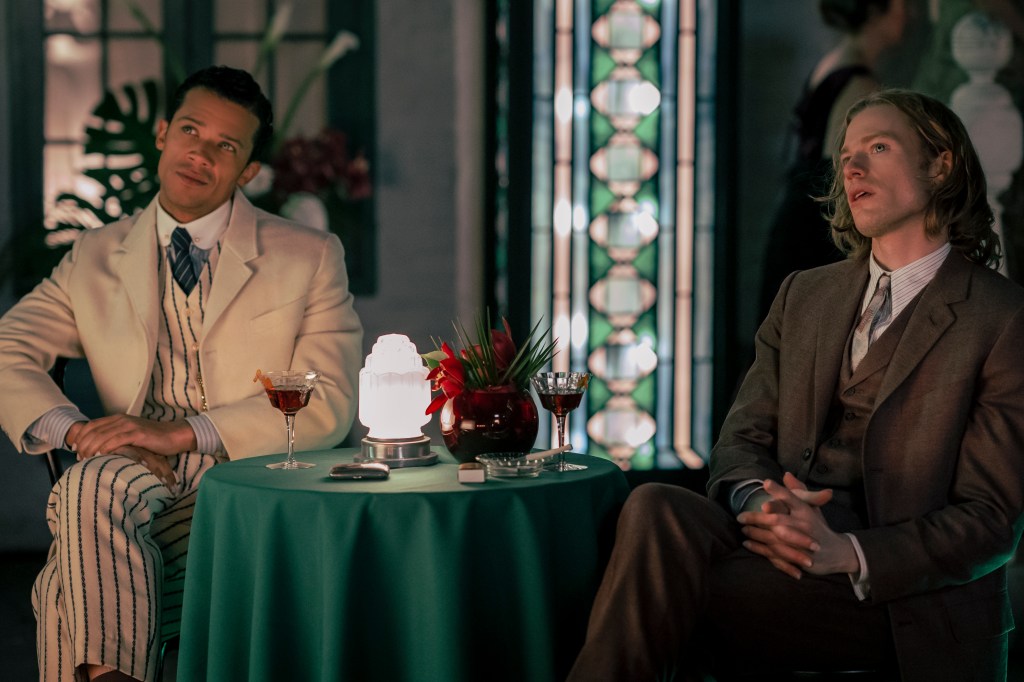

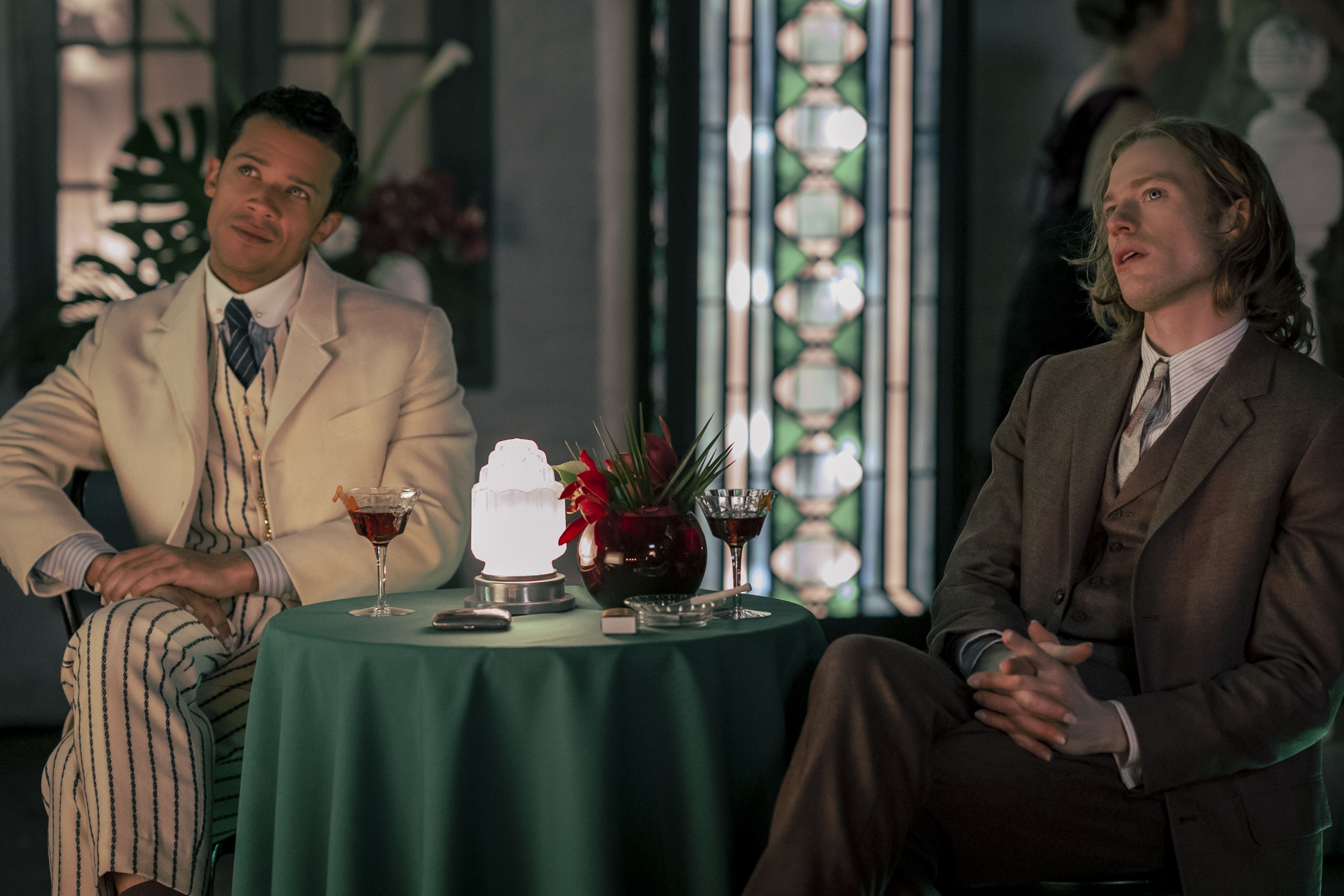
It was a “mighty tall ladder” to climb, but life at the top is truly as good as Louis always imagined. Under his ownership the Azalea has become the “brightest club in the district.” It’s successful enough to continue providing his loyal, beloved employees generous salaries. And on top of star performer Jelly Roll Morton, they just hired a new singer who heard about the place “all the way in Atlanta. They talking about this place in Atlanta!”
“1917 sounds like it was a pretty good year,” Daniel agrees.
Tensions even appear to have cooled with Lestat; in contrast to the frightening scene that closed the previous session, this one opens on a midnight date in Jackson Square, before Louis takes his nightly victory lap at the Azalea. It’s reminiscent of their early courtship, playing docent to the new, mysterious gentleman in town—save for one key difference. Two sessions ago Jackson Square meant comfort, an opportunity for Louis to shed his armor and share himself with someone other than Paul; now he and Lestat sit in silence.
Lestat casts about for topics to rekindle that early magic. “There’s a column in here about the history of this lovely square,” he tries. “It says that the man who designed it did so after the Place de Vosges in Paris.”
Louis doesn’t bother to look up from his novel. For one thing, the history of the Square also involves the public execution of runaway slaves; for another, it appears the tenor’s death is still weighing on him, even after half a year. Humiliation. Complicity. A lifetime of joy destroyed in half an hour. The fear that stopped him from objecting in the parlor no longer factors. “Should we be more selective? . . . The ones you admire; the poets, composers, the thoughtful man who designed this park you love so much. Shouldn’t we spare them the randomness of our killing? . . . We should be better than they are.”
It’s Lestat’s turn for disinterest. No one knows better than he, after all, that if you “thrust [any human] into circumstance, whisper to them their Lord, God and Savior is not listening . . . you will see all kinds of depravity.” Nonetheless, a rare and well placed “mon cher” gets him off the bench and testing Louis’s theory.
He has some questions of his own, as they stroll through Storyville. How do we decide who’s bad enough? How long do we wait to confirm they are? “Say we come upon a murderer planting a flowerbed, thinking only of flowers.” A thief finally meets Louis’s requirements; Lestat prepares the victim before they can dawdle any longer.
Louis, faced with exactly what he claimed he wanted, grabs the nearest cat instead.
Aren’t I enough?
This disastrous date is only a portend of things to come. Over the next few weeks Louis will find himself inundated with questions about existence, morality and himself, as every last vestige of his human existence is stripped from him. 1917 was, he corrects Daniel, rigged to burn.
World history matches up to this watershed moment in Louis’s life. The U.S. is about to enter World War I, and Ordinance No. 4118, enforcing racial segregation in Storyville, has been passed. According to the ordinance “all prostitutes of colored or Black race [must] move their business across Canal Street.” This sudden change would set Louis up for financial failure—and it doesn’t escape his notice how his own clientele comprise the same men who signed it into law.
Tom and Fenwick, predictably, deflect and deny. Fenwick is but one man on a council of 17; “It’s Woodrow Wilson, this war he’s backed us all into. . . . Washington’s making us choose, Louis.”
Louis finds that hard to believe. It feels personal, to him; like “an affront to a Creole man who had outpaced his fair-skinned competitors,” like a “boot on my neck.”
“I prefer the days you let us win on occasion,” Tom admits. “Days of deference.”
Despite the outrage, Tom and Fenwick are as easily dispatched as ever. Louis grants his girls a clever, generous 5% of the business, thus enabling them to file a writ of injunction against “use of property” and halting the ordinance.
Lestat is, eternally, less easily managed. He broods at the Azalea over Louis’ sudden shift in diet, which seems like an overreaction, except he’s realized something: “You’re ashamed of what we are.” Louis reacting like the word vampire is a slur doesn’t help.
“Maybe I’m just pondering what I am,” Louis deflects, but Lestat sees through it, just as he sees through Jelly Roll’s plan to quit the Azalea. He saves Louis’s star performer, but things have soured when we return to Rue Royale two weeks later: Louis has begun his animal diet, he and Lestat no longer have sex, and Lestat is about to take up with the Azalea’s new singer Antoinette Brown. Nothing too important, for the audience or Louis: “I let it happen,” is the breezy Dubai explanation. If his 1917 version stalks off it’s due to dinnertime, and the expectation Antoinette will be gone when he returns.
Instead, he’s once again given exactly what he wants: Antoinette has “talents,” and has been spared. And once again, the reality is not what Louis had in mind.
“Aren’t I enough?” is all he can ask—and receives a peal of hysterical laughter in response.
It’s a question that could apply to them both this session, though part of the issue is neither can realize it, and it’s worth examining how we reached the drastic step of cheating, even if our narrator deems it unimportant.
Lestat’s cheating may seem vindictive, petty, an overreaction—and it is—but what he’s responding to is a shame he senses goes deeper than mere diet, encompassing who they are, how they live, even what they’re called. It’s a shame, therefore, intrinsically tied to himself and what Louis must feel for him. (What do we keep saying vampirism is a metaphor for?)
Compounding all this is the fact that Lestat isn’t sure exactly what Louis feels for him. Verbally he subsists on almost nothing, four decades of I love yous to be left unanswered, and now there’s no physical side to the relationship either. Aren’t I enough? Lestat’s laugh is directed not at Louis but how ludicrous he finds the question. He searched over 100 years and found no one Louis’s equal. Louis is more than enough—but the sentiment, from his perspective, is not reciprocated.
It’s true Louis’s struggles to accept and express his love for Lestat are a running theme and an important, unresolved part of his character arc, but Lestat’s own issues and insecurities in turn blind him to some of Louis’s progress. Maybe Louis withholds verbal declarations—but he is making a daily declaration by simply living with Lestat; every time they appear together in public; bringing Lestat to his table and business meetings at the Azalea. Everyone from his mother to Bricks to Fenwick knows precisely what those actions mean, and make sure Louis knows they know what it means. He may not say the words but he is, essentially, out, and he does it for Lestat.
Ironically, Lestat actually did get exactly the response he was angling for in this scene. “Aren’t I enough?” asked a lot of Louis, was a moment of great vulnerability, an admittance that he does care and is hurt—and, from his point of view, he receives a laugh in his face, after his partner just cheated on him and informed him he intends to continue doing so. He’s the one being told he’s “not enough,” and so it’s no wonder he decides to open their relationship in retaliation. WWI is only too happy to facilitate in the form of Jonah Macon, “an old love,” Lestat guesses.
“We had a few early tumbles,” Louis corrects him. Jonah was 16. Louis was . . . older. Jonah has been traveling the U.S. for a few years, doing first hotel work, then a stint in a gunpowder mill. A coworker losing three fingers prompted him to enlist in the army. “Thought this might be a way to rise through the ranks, and all that.” He’s also keen to experience Europe, where he hears “they care less what you look like or who you’re looking at.”
Someone up on the balcony has been looking very hard at Louis throughout this catchup, at least whenever he separates from Antoinette Brown for air. For the first time in two weeks, Louis extends an invitation.
A ride to the bayou in Louis’s pretty new automobile is meant to impress, but Jonah didn’t need it. “Easy living Louis,” as always.
“There’s nothing easy about my life,” Louis protests, giving Jonah a crash course in Lestat. It’s “a lot.” It’s “not perfect.” Still, Jonah insists, Louis has been blessed, especially compared to himself. Louis remains mostly clothed as Jonah strips, and sinks into the mud, and the actual origins of Louis’s diet are confirmed.
In Jackson Square, Louis built his new feeding criteria around the concept of sparing the good or “worthy,” citing poets and composers as examples and thereby linking his issue to Lestat’s horrific, humiliating treatment of the tenor—yet moments later refused his own perfectly imperfect candidate. Lestat interpreted this refusal in terms of shame and superiority. There are undoubtedly elements of both, but what Lestat couldn’t hear was the heartbeat pounding in Louis’s ears, louder and faster still when Lestat tore off one of the thief’s fingers, unleashing a fresh stream of blood.
The same happens now in the bayou, as Jonah kneels before him. His heartbeat quickens with desire until it becomes all Louis can hear, until he has to tear into his own arm for relief and restraint. What’s triggering these moments and this diet is no twisted sense of morality but the same uncontrollable urge that sent him fleeing Grace’s living room; whatever still undefined lack of control that leads Louis to think himself “botched,” unsuited to the lifestyle, has left him crying on his bed. It’s a matter of (perceived) inferiority rather than superiority, and it traces back to Benny.
Oh joy, oh boy
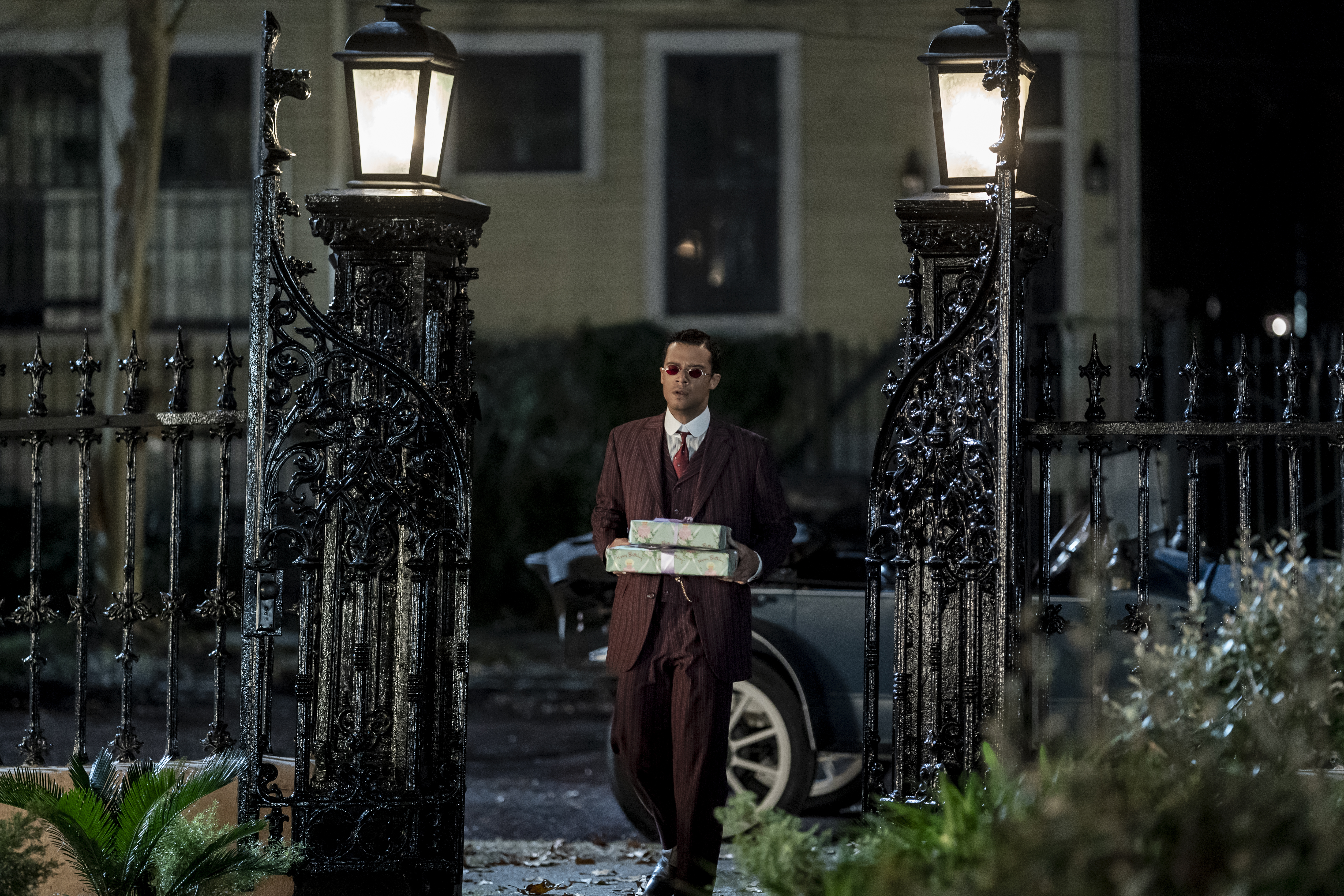
The domestic theater is not one but two fronts. On top of Lestat’s general existence, it’s Louis’s nieces’ birthday, and there are family obligations to attend to.
They don’t seem as willing to forget Benny as Louis is. “Here comes the ghost!” scream the birthday girls as Louis enters the gate. “Run! He’s going to get us!” We learn from Florence six months have passed since they found Benny on the floor, and Louis is no longer welcome.
“I own this home,” he corrects her. “Welcome don’t matter.” He grows increasingly agitated when Levi, whom Florence refers to as “son,” intervenes.
“I’m your son!” Louis retorts, shoving, shouting and finally kicking his way through the front door, where he finds Grace, the only one he actually wanted to see, standing before him in shock and terror. His mother circles him to look straight into his eyes.
“What did I tell y’all? There he is. There he is.” The devil walks at night, as she pronounced upon his arrival.
Rejected even by Grace, shaken by Florence’s words, no longer “son,” Louis returns home to yet more chaos, and Lestat more than halfway through a breakdown in a townhouse full of American soldiers. “You can fuck them,” he pants, drawing Louis close, “and I can eat them.” The truth comes out: Lestat was spying on Louis and Jonah, A LOT has been running on a constant loop in his mind ever since, and he doesn’t like sharing, never mind the fact that he started it. Everything he’s been feeling the past two weeks comes pouring out: Antoinette is nothing. Louis was supposed to respond to her the way Lestat is responding to Jonah now. Lestat is shocked by the depth of Louis’s shame, that he’d rather crawl around alleyways for rats and dogs than accept who he is. “THIS IS NOT A LIFE!”
Finally, it’s Lestat’s turn to get some of what he thinks he’s been wanting. “That’s ’cause you took MY LIFE!” Louis screams back, past his breaking point. “I got nothing! I lost everything!” Brother and family and the “last fucking thing” he cares about, the Azalea, if he doesn’t think quick.
It’s intended to wound, and does. We’ve never seen Lestat look less human or out of control than he does during this fight, face ashen and streaked with bloody tears—and his response is, interestingly, to shut down. He won’t do much more than sit in chilly, lofty indifference until Fenwick’s death.
While Lestat retreats into his cards, Louis scrambles to save the last thing he has. The situation is quickly spiraling out of hand, as the city has shut off the Azalea’s electricity, yet no punishment has been doled out to the “dirty house” across the street owned by a white man. Tom and Fenwick offer a number of “solutions,” such as moving across the Quarter with Lestat as the public face of his operations, that are so demeaning and impossible Louis tunes them out to read their minds for the truth. What he learns sends him reeling.
“Did you sell me the Azalea,” Louis bites out, “because you knew this day was coming, Tom?”
They were never jealous of him at all, or at least not in any way that mattered. The Azalea, Louis’s pride and joy, was bought for a poor price, Tom and Fenwick have been laughing behind his back the entire time, and they’ll be more than happy to buy it back for 15 cents on the dollar.
Maybe in the end, Louis hears, you’re a dumb pimp who got robbed blind years ago.
Nickels, dimes, quarters
What happens next isn’t about the money or the fact that he’s been getting duped for half a decade. What happens next, Louis asserts, is a stand against “that snake biting me and my people.”
He undercuts himself in almost the same breath. “We don’t need the money,” Lestat drones, as Louis applies the finishing touches to a COLORED ONLY sign for the Azalea’s front door. “You have your investments on the Claiborne Avenue.”
“What,” Louis slips, “hats, little grocery stores? Nickels, dimes, quarters!”
“So it is about the money,” Lestat sighs.
His people, especially the minority owners in his business, are crucially, similarly skeptical of his plan. Tom and Fenwick’s racism is not in dispute, but Bricks and the girls think the sign is “fucking stupid,” jeopardizing both their livelihood and Storyville, where Louis does not live and would not face any consequences.
Louis in Dubai can admit he was “inviting chaos,” but their protests fall on deaf ears in New Orleans. His white rivals point and laugh at him in public; Fenwick keeps issuing ordinances, smug and eternally confident in himself and his ability to crush Louis; Louis is “manic” at their hubris.
He’s also hungry. It’s nothing serious; just a few skipped meals, losing track of time defending Storyville—and also two weeks of impotence, barely enough energy to hold a book, thirst growing “harder,” temples throbbing, a heartbeat pounding in his ear for the third time. It is in this “manic,” starving state that Louis finds himself in Fenwick’s study, and though he claims it’s about his people, their showdown is all about him.
Storyville is a sinking ship, and naturally, you are the first to drown. But that’s your problem, Louis, always has been. You’re arrogant. You haven’t accepted your place in this world. And your pale lover, with his seemingly endless supply of capital, and the weird goings-on in your sodomite townhouse won’t change the fact that you’re a tiny man flying too close to the sun. And that’s what I am, Louis . . . the sun.
Louis is surprisingly calm during this onslaught, and as he approaches Fenwick’s desk. But still waters run deep.
He starts with Fenwick’s ear, then a slash on his cheek, and a diamond hard nail straight through his chest. Before the night is through he’ll tear Fenwick’s torso from rib to bowel so the entrails slip out. He’s shaking with an excitement and release that’s new and, as we keep returning to in this episode, personal. “You said I’m arrogant? Maybe I am arrogant!” Where before he could not stand to hear the word in his place of business, he wants this to be the final thing Fenwick hears before he dies: “I’m a vampire.”
Into circumstance
Did you not smile when he begged? Did you not feel pleasure as you carved him up? That garish display of his body, like some public art piece, was for your people?
It’s only the latest batch of questions for Louis to wrestle with, when he returns to Rue Royale after hanging Fenwick’s mutilated body on his gate as a warning. A riot rages outside the window; his moment of triumph has come at a high price. His horror is real but the defenses familiar and hollow. “I didn’t do it for me. I didn’t see this coming. Maybe you saw it coming, and didn’t stop me.”
His equivocation, however, is nothing compared to Lestat’s total apathy. “We should make this our anniversary,” he croons one moment, rolling his eyes and dismissing the racist mob terrorizing Louis’s community the next. “It’s as I say. Toss [humans] into circumstance, they go for the throat.”
It seems, as it did with the tenor, Lestat’s cruelty provides a moment of clarity, helping Louis finally draw a line between what he is and is not. “And that’s why you and me ain’t never gonna work,” he decides. “That’s why you’re always gonna be alone.” He leaves Lestat and Rue Royale for good—or at least the next half hour.
The destruction outside is total and overwhelming. Fire rages for miles as white mobs swarm the streets, attacking mothers trying to escape with their children and firebombing any building within throwing reach. The Azalea is burning, and with it much more than a business—everything Louis ever worked for or “wanted or wished for.”
It’s only fitting. It is he “who should pay for this sin,” he laments—yet the responsibility is still qualified, like the excuses he gave Lestat on Rue Royale. He assigns a naive sort of innocence to his role, describing himself as an “irrational child who had tested his strength on the small bird and now asked, ‘Can I make it whole again?’” And despite leaving Lestat to take responsibility for his mistakes (“That out there, that’s on me. . . . And that’s why you and me ain’t never gonna work”), despite his supernatural strength, he cannot seem to find any way to help—until he hears a single voice out of the anguished chorus.
“Light,” says Louis, “redemption,” rebirth. He follows it.
It’s interesting Louis opens this third session on a contrast to the first, one intended to illustrate how much he’s grown apart from and beyond Lestat, because there are some striking similarities between both episodes’ endings, particularly what Louis reveals about himself in his confessional monologue. “I profit off the miseries of other men,” he admitted then, and Storyville burns around him now. In the last two episodes he returned to “stuffing cotton in [his] ears” about the ethics of prostitution; he just ignored Bricks’s opinion as she tried to protect the business in which she’s now supposed to get a say. Sister and mother lost again “and rather than fix it like a man should, Lord, I run.” In the Church, faced with uncomfortable truths about himself, his life unraveling around him, his cherished brother lost, Louis grabbed onto something Lestat promised would make him better.
Now, with everything Lestat derided as vestiges of humanity and phantoms of his former self finally turning to ashes around him, in a moment he describes as a splitting, “where who you were before and who you would be forever after is marked in time,” Louis takes Claudia and runs.
Noteworthy:
- One of the pillars of this second interview is Lestat’s racism, which makes it strange Louis so blithely credits him with a Black man’s work (Morton’s song “Wolverine Blues”), especially one who was an innovator in jazz.
- “’Cause you took my life” is an interesting statement from Louis. He can sometimes sentimentalize parts of his human life, presenting even dark things like the aftermath of threatening Paul in a whimsical light, but there were major issues in that human life that would have erupted eventually, with or without Lestat, with or without turning. Louis was “bone tired.” His only friend besides his siblings was a woman hired to beard. He felt burdened to provide a certain lifestyle for his family, soon to include Levi and any children he and Grace might have. Paul’s care was an ongoing debate. A final, glaring issue: his sexuality. What would Louis’s life have looked like in that area, if he never met Lestat?
- Daniel spends most of this episode listening, though he does make two important interruptions. One of his questions derails the story completely: “Was it raining?” Louis can’t remember. “Rashid” is lingering. The possibility that major details of memories can be altered has been introduced.
- His second interruption regards narrative. When pressing Louis on the “Wolverine Blues” authorship, he calls the current interview “rehearsed,” a “total rewrite” of the first and notes the unique depiction of “the abused-abuser psychological relationship. . . . I mean, usually when you’re a little too close to it, the abused still loves the abuser, but you flipped it completely on its head.” Louis’s rebuttal: allow him his odyssey.
 deep focus