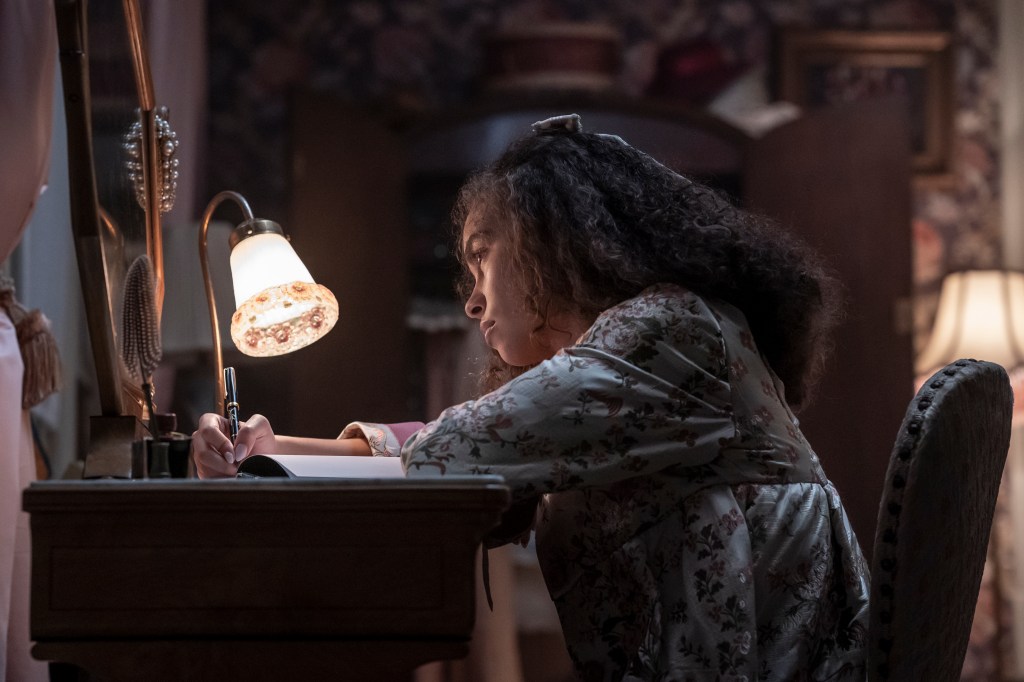

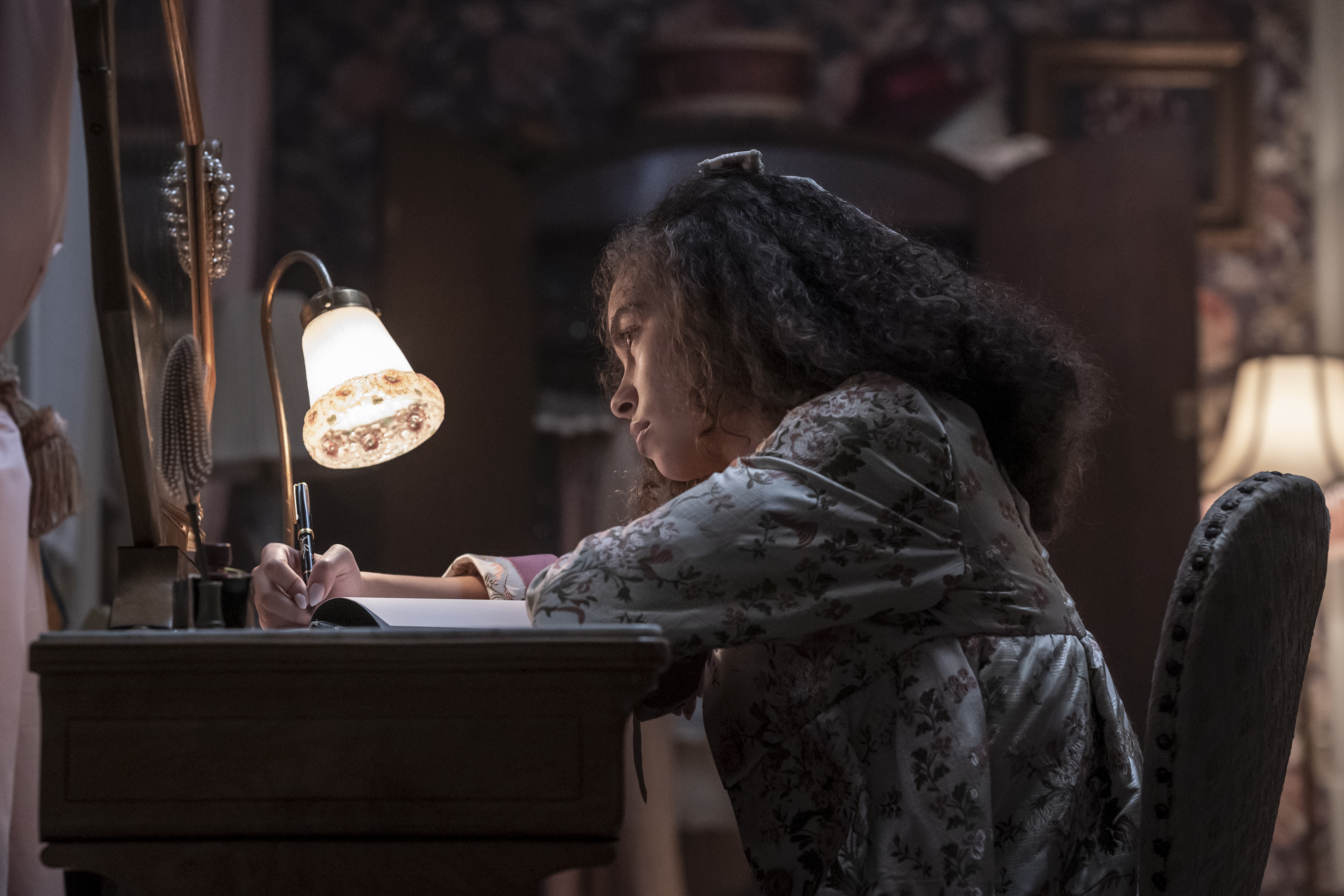
Claudia opens her second four years later diary with the announcement she has her own room aka how long did they make her share a room with them. Bailey Bass as Claudia in Interview with the Vampire. Photo Credit: Alfonso Bresciani/AMC
For the next phase of the interview, Daniel is led into what is euphemistically referred to as the reading room. It contains a bookshelf only one resident seems able to reach and is built of the same stark lines and natural stone as every other room we’ve seen so far, but there are enough unusual touches to make it noteworthy. A blue wash lends the space a tranquil aura; there’s an ornate desk that fits with none of the penthouse decor, but wouldn’t be out of place on Rue Royale; a tree under artificial sunlight takes up nearly half of it.
“The interior designer hired was a sentimentalist,” Armand apologizes. “Some notion of hers [Louis] was missing the natural world.”
It is, we will learn, a room of particular importance to Louis, but he, being neither ancient nor powerful enough to withstand sunlight, is currently resting. Armand directs Daniel to the desk in his stead, upon which he will find several boxes of old, battered diaries and the pair of museum gloves with which they must be handled. The session is a departure not only in setting but narrator: the show’s actual best dressed, Claudia probably not de Pointe du Lac definitely never de Lioncourt, has arrived, ready to guide us through the next four years.
Like Louis, she can remember the riot, though unlike Louis she doesn’t seem to recall screaming for anybody’s help. “I closed my eyes,” she writes, “and waited for the fire to take me, too. I just prayed it wouldn’t hurt too bad.” Onscreen, we watch her quietly resign to her fate—until “the Black angel came. He was beautiful and strong and fast, and he carried me like I was made of feathers.”
The destination is not a hospital but Rue Royale, and the partner Louis left what must be no more than an hour ago. At that time Louis had identified a fundamental, insurmountable difference between them—Lestat’s apathy for people, particularly Louis’s people—but he is now, it would seem, Louis’s only hope to save Claudia.
Lestat, of course, needs to understand what’s in it for him. “You were ready to abandon our home,” he sneers, as Claudia struggles for breath on their bed. “She’ll be, what? A dog?”
“Not,” Louis stumbles, “not a dog—”
Lestat’s face changes as he grasps what Louis already knows. “A daughter,” he breathes.
Louis is shaking but resolute. A long moment of understanding passes between them, Louis’s fist in Lestat’s shirt, an appraising hand tracing the side of Louis’s face. Lestat strides to the bed, gathers Claudia in his arms and, though he knows she is far too young for it to be a good idea, opens his wrist for her to drink.
Louis, who remains at the foot of the bed, twitches and flinches and needs to clear his throat as Lestat drains Claudia.
Her hand in mine
Louis was preyed upon at his brother’s funeral, driven to alcohol, stood witness to the systematic dismantling of his tightly knit support system (paid beard and babysitter priests). Lestat was kidnapped, tortured and forced into turning by his own maker. Armand’s origins will wash both these stories. “All vampires are born out of trauma,” as Louis will tell us next episode.
Claudia’s origins are indeed traumatic, but she’s the first one who doesn’t seem to mind. Louis and Lestat recoiled from their first tastes of blood; Claudia injures Lestat seeking more. She delights, a night into her turning, at being called a “devil.” She’s too dazzled by her new surroundings to question how she got there, and for four years she, Louis and Lestat make a deliriously happy, if somewhat odd, family.
Nights are filled with dancing and bonfires (of a sort) while days are spent in a pink satin coffin, a far cry from the poverty Claudia experienced as a human. She ends up having more in common with “Uncle Les” than anyone originally thought, but the bond between her and “Daddy Lou” is obvious before they even unlock the telepathy Lestat has sacrificed as maker.
Amidst all the fun and frivolity, however, are a few notable absences. Last episode closed with Louis wandering the ruins of Storyville, consumed with guilt over the riot, begging to help. The Azalea was the “last thing” he cared about; he’d chosen Storyville over Lestat. What seems no more than a night later, he’s on madcap hunting (and shopping) trips with his newly repaired and expanded family. His environment narrows from busy streets and business meetings to family activities almost exclusively in the home. Storyville will be referenced only once from now until the end of the season; the Azalea and his girls never.
Louis won’t directly address his pivot, but there are a few statements to mine. He seems suddenly willing to admit Lestat may have had a point about chasing phantoms, for one thing. Claudia silenced “all the noise,” he tells Daniel, “the chaos, the crisis of my former existence.” He indulges in panegyric on “the simple joy of her hand in mine.” She became “everything” and their bond will trump everything, including ultimately Lestat.
This, of course, will be contentious. Claudia was a “band-aid for a shitty marriage,” Daniel pronounces after two diaries. His takeaway after seven episodes is even more damning: “You chose Lestat over her, time and time again.” We know the escape narrative built around their unbreakable bond has been altered, to whatever degree, and would have hidden Louis’s own abuse of Claudia.
With these things in mind, it’s easy to identify potential issues in Claudia’s introductory episode as early as the opening moments. We don’t, for one thing, actually know why Louis returned to Lestat.
The obvious answer is Louis couldn’t turn Claudia, but this is more guesswork. Claudia, we will learn in 1.05, physically cannot turn vampires, but Louis’s ability—or lack thereof—is never acknowledged, much less defined, at any point in the season. What we do know is he likely turns Madeleine in season two, and that his animal diet caused weakness, and that he fed on Fenwick, his first human in a few weeks, the night before finding Claudia.
If Louis possesses the ability to turn vampires; if we presume he was at full power at the end of 1.03; if he’d just left Lestat for jeering at a riot, why bring one of its victims home knowing she would be “daughter?” Claudia will ask him a version of this question in 1.05—why not take her to a hospital if he wanted to save her—and Louis will have no answer.
Even if it turns out he can’t make vampires, there’s another issue with the construction of this chapter of the story. The Azalea had been Louis’s dream since he was human. He took enormous pride in its prestige, his own business acumen, the way his success trickled down to help those less fortunate. He’s allowed to close his business and switch to parenting if he wants, but the problem lies along the lines of Daniel’s complaint in 1.03: “It’s not so much the minute details, Louis, rather the total rewrite that’s giving me pause.” Here, it’s less rewrite than sudden, total omission of what had been major parts of his life. Every trace of his former existence—girls, investments, businesses—essentially vanishes from the narrative, less than a night after the riot . . .
. . . and Louis’s humiliation at the hands of Tom and Fenwick. Considering last episode climaxed with him proclaiming his arrogance, the timing doesn’t seem to be a coincidence.
If the Azalea was less altruistic than presented—if it was, ultimately, more tied to pride and the “crisis” of his existence, so readily discarded after humiliation and failure—what does it mean when it’s abruptly and wholly replaced with something else? Could the sudden domesticity be not fulfillment but perhaps a bit of retreating, avoidance, licking his wounds? Is this behavior—running, replacing—part of a pattern we may see continuing in Dubai, as he sits before us with a new style, voice, demeanor and story?
His statements on Claudia are revealing, in how they aren’t about her at all. “I just need her not to die” and daughter were all he could come up with as he pleaded for her life. As soon as he heard her cries his thoughts were of his own redemption. Claudia silenced “the crisis of my former existence.”
In the meantime, it will become increasingly difficult to see how turning benefits Claudia, if it ever did.
Measure yourself
Considering how the end of the season goes, Claudia is ironically the first to give us an unguarded glimpse into Louis’s love for Lestat. She races by them sprawled on the couch in deep conversation. Louis beckons Lestat into his coffin when he thinks Claudia is sleeping. I missed you, he whispers to Lestat’s incredulous delight. I hate sleeping without you. “How does love between two men work?” Claudia asks during a fishing trip, and Louis’s face crinkles up in joy. “Works like love,” he replies.
She also offers us our coldest view of him, and what may be one of the most significant memories from season one. Claudia’s recollection of Florence’s wake shows a side of Louis we’ve never seen before, or never so nakedly.
It’s a new side of Grace, too, as she speaks to Louis with open disgust. He’s aloof and mocking at first, but that demeanor changes when Grace demands to purchase her and Levi’s house in installments: “You and your white daddy are doing fine in the Quarter.” Louis takes a threatening step closer.
“You forget what I did to that door, Grace? You should measure yourself.” With that he gathers his new family and sweeps out of the wake.
This scene is such an anomaly that we can’t yet know how it fits into the “odyssey of memory,” but the ramifications are potentially enormous. Aside from Paul, Grace is the only family member Louis loved and truly wanted to see after he turned. He showed us his heartbreak both times he accidentally hurt her. To treat her with such cruelty and callousness—after hurting her son and kicking her door in; to the point of physical intimidation—would have been unthinkable one episode ago.
The wake marks the beginning of the end of their happiness, according to Claudia: “The phone rang . . . and all the easy times stopped.” But even if she didn’t sense anything, Louis and Lestat have been keenly aware of the existential cloud hanging over her head since before they turned her. “She’s too young,” Lestat protested as Louis pressed him for a daughter. There have been necklaces too large to fit a girl who never grows, a bottomless, eternally youthful appetite. During their aforementioned fishing trip, Louis confesses his lingering guilt in her turning: “Some killing has consequence. The fire in your house was a consequence.”
Claudia is touched by the next exchange—
LOUIS: I used to get a little caught up in human affairs.
CLAUDIA: Then what?
LOUIS: Then you.
—but has no response to the revelation that he played a role in the riot that permanently altered the course of her life. That’s absurdly understanding and extremely convenient for her new parents, if so.
It ties into a deeper issue spanning the entire season, which is, though we’re supposed to be getting Claudia’s perspective, I’m not sure how often we actually do—or, maybe, how often that perspective centers herself. She rarely mentions her life in Storyville. She doesn’t care Louis played a part in ruining it. She has no qualms whatsoever about accepting a pair of strangers as her new parents, to the point of sharing a bed with one of them. We don’t know her last name.
As we said in 1.02, it’s not so much an issue of characterization as execution, and what can sometimes feel like a lack of curiosity into Claudia. You could, for example, argue that Claudia doesn’t dwell on her life in Storyville because she grew up in an abusive environment. But we never see any struggle or choice, and only know about the abusive environment from less than a handful of lines.
Likewise, to call 1917 to 1921 one of the biggest transitions of her life is an understatement; it’s no longer even life. Yet the only times there are problems, she writes, are when Louis and Lestat butt heads, and Claudia must resolve them, likening herself to a buffer in a statement that goes deeper than she realizes. What are her thoughts on jumping from abject poverty to endless luxury? How did she adjust to suddenly having zero friends? How did she handle that for four years? What are her feelings on her mother? If she has none, why not?
Much like with Louis, it’s presented almost as though a chapter’s been firmly shut on the Storyville portion of her life. It will only get worse as the season goes on and we are denied her feelings on events including her own rape, and her role in the narrative becomes “savior.” Whether these are Louis or Rolin problems remains to be seen.
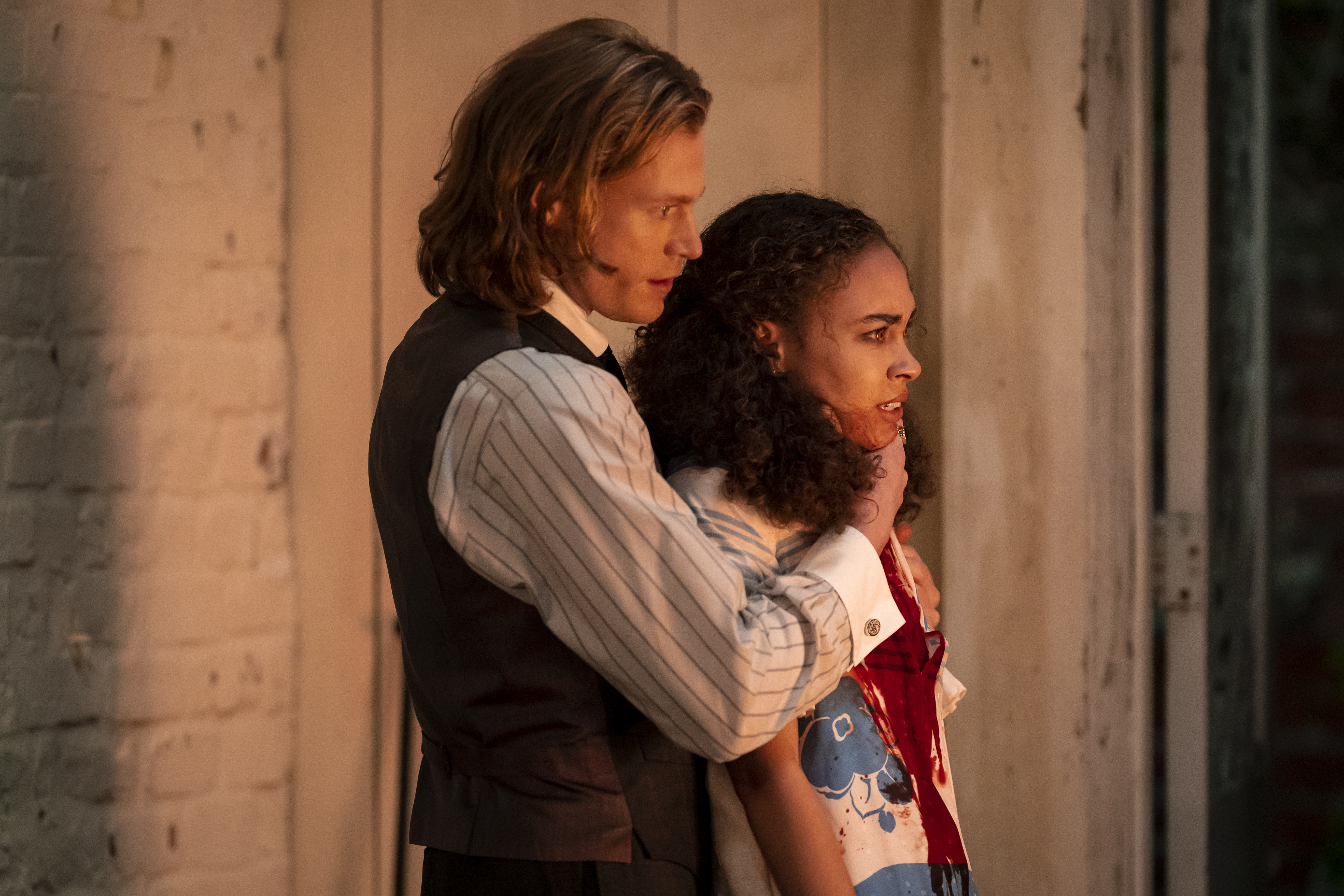
Lestat berates Claudia for the same thing he did for two weeks or half a year. Sam Reid as Lestat de Lioncourt and Bailey Bass as Claudia. Photo Credit: Alfonso Bresciani/AMC
Remember this
The real trouble starts, inevitably, with Lestat. An uncle-daughter hunting trip to Lover’s Lane brings Claudia’s existential crisis into sudden, glaring focus: at what should be 18 years old, perhaps even experiencing her own Lover’s Lane rendez-vous, Claudia is in exactly the same place, physically and mentally, as she was the day she turned almost four years ago. She’s missed every normal teenage milestone, and nobody in the house cares.
Seeing as both fathers have been content to treat her as a sort of living doll for the past four years, Claudia takes matters into her own hands. She ditches the babydoll wardrobe for something more current and them at home for a night on the town. She meets a sweet carriage driver named Charlie; a spooked horse turns into an ice cream date turns into making out in his backseat, and the montage is over as fast as it started. Too lost in pleasure, too “loose” to realize she’s been feeding on him, Claudia kills Charlie by accident.
In the townhouse she is desperate to undo it, turning to the only vampire she knows can save him. Lestat is physically distanced from his family and unsympathetic. “You drained him dry,” he simpers, casting Claudia off with a careless push. “Now, go on, clean up after yourself.” She flees in tears, and he earns a sharp look from Louis.
It may be what sends him into the courtyard after her. When she tries to leave he holds her there.
While he dismissed her with a strange, patronizing sort of indulgence in the parlor, for some reason Lestat has grown serious. He is firm but not, I think, punishing. “Remember this,” he says, “his face as it melts. This is why we never get close to mortals. Sooner or later, they end up dead.” He seems to speak from some type of experience, though what that could be is a mystery, and more than a little hypocritical, as the murky timeline indicates he dated human Louis around half a year.
If he is trying to impart any lesson, it’s lost on Claudia as Charlie turns to ashes before her.
Mind and spirit
Louis drops into the library just in time for the aftermath, “one of the darkest eras in our lives.” Daniel has questions—chiefly, where these diaries were in 1973—but Claudia’s story is not yet finished.
Their idyllic life shatters, it seems, almost overnight. With Claudia unwilling to play buffer, Louis and Lestat are back to constant fighting. She is inconsolable and vengeful over Charlie’s death and the lonely, empty, immutable existence that stretches before her. She spews vitriol into her diary, sparing no one: she went from beatings at the boarding house to being “raised to kill by two demons.” That death she was ready to accept would have been preferable to her hellish existence trapped in a teenaged body as her “mind and spirit” continue to age. “How does she even get up in the morning?” anyone who heard her story would wonder. She cycles through extreme emotions, sobbing one moment, laughing hysterically the next, tearing at her face as she screams and shakes alone in her coffin. Most alarming of all, Claudia has begun self harming by deliberately exposing herself to sunlight.
“If you were to come across [your daughters’] diaries,” Louis asks, “and learn, in detail, how and when you failed them, would you share those failures with a brash young reporter you met at Polynesian Mary’s?”
It’s a question any parent, even an estranged one like Daniel, would find impossible to answer.
Noteworthy
- It’s already well known that an excerpt from The Vampire Lestat appears on screen as an entry in one of Claudia’s diaries. For a show whose tagline is “Memory is a monster,” this would seem like an extremely random, careless error to make—but it does often feel like a fine line between analysis and tinhatting, the more these types of errors pile up. We’re the first to admit we have no idea if this show is intentional or just sloppy.
- To wit: in 1.03, a newspaper article we can clearly read on screen states Fenwick was “found slain in home, blood drained” and “Alderman Fenwick found murdered at his home,” yet Louis strung him up at St. Louis Cathedral.
- Halfway through the episode, Daniel remarks, “For a killing machine, I kinda like [Claudia].” He’ll become much more negative about her from 1.05 on. When does his negativity start? Is he faking it to get a reaction from Louis? How does it compare to his general refusal to comment on Lestat (the individual) at all?
- Claudia’s first diary begins in 1917 and ends we don’t know when. The next one starts in 1921, four years later. It’s a strange, inconsistent diary keeping habit—and a convenient one, as we’ve already complained. Why would Claudia suddenly pick the habit back up in 1921, other than that the plot demanded it? Sometimes it feels like the family’s lives get paused until we have to hit our next plot point or whatever historical events the writers want to cover. Louis can blitz through five years like it’s nothing; we’re supposed to believe the family carried on in a deliriously blissful state for four years until one chance trip to Lover’s Lane.

