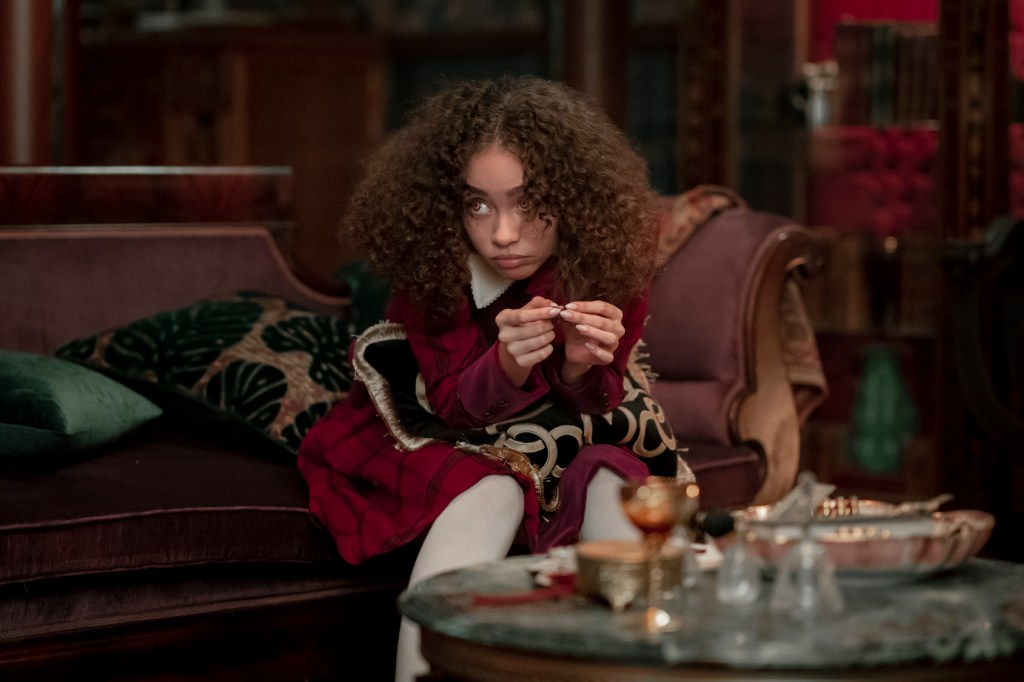

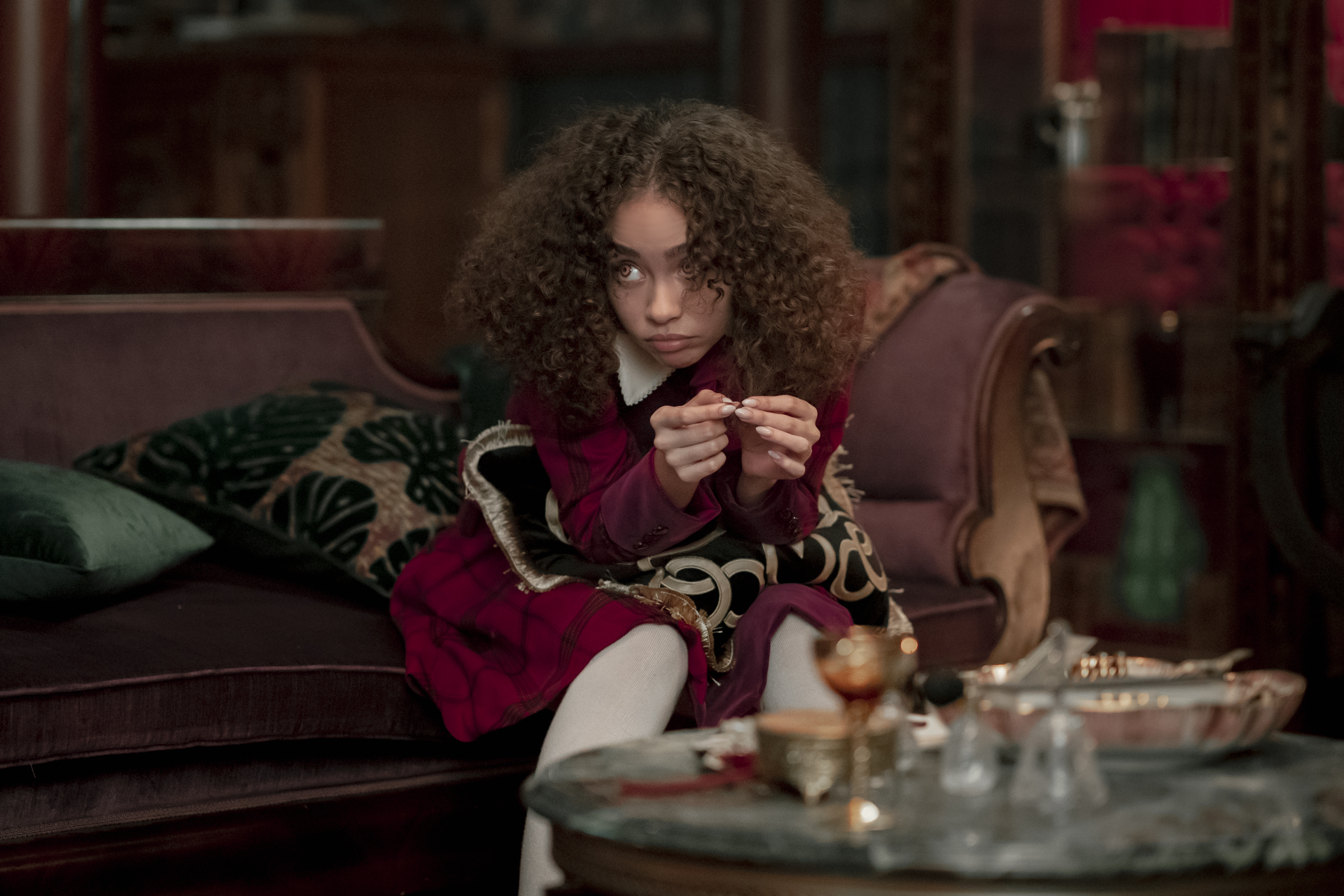
Bailey Bass as Claudia on AMC’s Interview with the Vampire. Photo Credit: Alfonso Bresciani/AMC
Trigger warnings: discussion of domestic violence and Claudia’s rape.
There’s a schoolteacher. Please, no. A window washer. I can’t die like this. A boy with his pet. Let my dog live.
Despite the 42-page kill list at one end of the table, and Armand serving as Louis’s lunch at the other, he and Daniel only seem to have eyes for each other. Daniel offers a succinct summary of the list, this moment and his life since the past week: “I can’t think of anything more fucked up than this.”
“And how is your work any different?” Armand counters. He submits a third potential motive for this interview: “What do you think will happen to Mr. du Lac when the other vampires of the world get their hands on [this book]? You are chronicling a suicide. Do not look down on Claudia.” Like Daniel, Armand will never address Lestat directly—will, in fact, never mention his name—yet feels quite comfortable speaking for Claudia. “Look in the mirror.”
Show suddenly over. Louis casts Armand aside and gets to the real point of this display: matchmaking, I guess? “What’s he taste like?” he purports to ask for Daniel. “Honey and pineapple.” Would Daniel like to sample? No. Can Louis read his mind? He claims to, which would then call into question why he (and Armand) won’t realize Daniel isn’t buying his story. Blessedly, we return to that.
In New Orleans, Louis stands in Claudia’s doorway snapping pigeons’ wings and tossing them at her coffin. It is empty, as any vampire should be able to determine by listening for a heartbeat, but it does not appear either parent has utilized this ability in months. Claudia has been, Louis is instead convinced, on a “hunger strike” since Charlie’s death, and he’s desperate for her to eat.
Lestat broods at his piano and dismisses Louis’s worries, insisting that Claudia waits for that “slither of time” while they’re both busy with their own hunts to sneak out, but he is not unconcerned. “I know what I’d do,” he says, fighting to maintain a semblance of dignity, “but you’ve cut my hands off. My parenting is—”
“Sadistic,” Louis, who moments earlier begged Lestat to capture and bind a man to leave coffinside, supplies. “She’s in there ’cause of you!”
Lestat slams the keys and storms into Claudia’s room.
He is right, as he will always be when it comes to Claudia. Her coffin is empty and her diary is dark, “inked with ungratefulness” for, notably, both parents, and also her hymen. Lestat can only make it a few lines in before he thrusts the diary away in disgust and flees the room altogether. The scene dissolves as Louis begins rifling through the pages.
As soon as she returns home, Claudia is ambushed and pinned to a dresser. Lestat’s hand at her throat holds her there.
“You gonna let him do this to me?” she asks Louis, eyes wide with betrayal and fear. Louis looks away.
“I read some passages out loud, I’m afraid,” Lestat answers for him. (He must have gone back in and retrieved the diary from Louis.) “Hurtful words for both your guardians.”
There was an entire separate volume overflowing with love, and entries filled with Claudia’s existential anguish and cries for help. Their single minded focus seems telling.
They press her for details on the 42 page kill list, “whole families, half a parade crew” she dumped in a too-shallow river. “What happens,” Louis demands, “when the next storm comes out the gulf?”
Comme il dit. The bodies wash up, bringing with them a crackdown on the city and unwanted scrutiny to the family. At a meeting with Tom, who is soon to run for the Louisiana House of Representatives, Louis and Lestat discover another gruesome detail: each corpse is missing a body part. Also: Tom lured them to dinner so the police could sweep their house while they were out.
They hasten to leave, which involves a command from Lestat: “One each.” Time slows to a standstill as Lestat carves an X into Tom’s face, while in the background Louis seeks out the chief of police.
What did Lestat mark Tom for? Can Louis also stop time, or are other vampires excluded from Lestat’s powers? These are but two in the long list of 1.05’s unanswered questions.
Mysterious tasks completed, Louis and Lestat rush to Rue Royale to find their townhouse upended and Claudia, whose latest meal has left her drunk and insolent, actively making everything worse. She stumbles off to hide her “souvenirs” as Louis and Lestat scramble to explain the incinerator in the backyard. The close call earns them warnings over their secret wine cellar and Claudia’s upbringing, and something a shade darker as regards the single bed in the boudoir. The officers are barely out the door before her parents round on Claudia.
LESTAT: You wanted her, you fix her!
LOUIS: We’re doing this together!
LESTAT: Do you remember our life, how happy we were before her?
LOUIS: Happy? We were not happy.
LESTAT: An anvil, tied around our ankles, pulling us towards the pitch-black ocean floor!
CLAUDIA: Who am I supposed to love?
It stuns them into silence.
“You two have each other,” she continues, identifying them, not herself and Louis, as the main, exclusionary familial unit. “What human would want me?” With an eternally maturing mind attached to a body fixed at the physical age of 14, there is nobody her “own age” to ever share her life with. Even if this unicorn existed, she wouldn’t be able to turn them—though not for lack of trying.
“Boy from Ponchatoula,” she laughs bitterly as Lestat grabs her bruised, bitten up arm in horror. “Boy from Hollygrove. Boy with the bow tie out in Algiers. . . . Make me one,” she urges.
“Because you turned out so well.” Gripping her chin like he wants to snap it off, Lestat extends Louis’s broken bird metaphor: “You are built like a bird . . . you are a mistake.”
Louis, to his credit, shouts at Lestat for this, but at this point it doesn’t seem to make a difference to Claudia. “He treats us like shit and you take it!” she screams, then rounds back on Lestat. “And you, cruel as the devil ever made, to refuse me one love when you’ve got two!”
She has, it turns out, been following Lestat for some time. (Unanswered question #3.) Claudia takes grim, momentary pleasure in taunting Antoinette, but seems mostly disgusted and resigned with it all. “He’s gotten tired of us, Daddy Lou. The housewife and the mistake.”
She is filling a suitcase when Louis follows her upstairs. He puts up a fight, but not much. “I know we made some—”
“Mistakes?!” Claudia keeps thinking about the night she was “rescued,” the life she knows remained in her body, why her wounds weren’t treated at a hospital. She shares the dreams and torments of what that future could have held—a plain, kind husband, children, a home of her own.
She nods, not surprised, when no explanations are forthcoming, and grabs her coat.
By now, this pretty woman he adored was his for life. The universe, for him, was contracted to the silken compass of her petticoat. He used to reproach himself for not loving her enough, he couldn’t bear to be away from her; so he hurried back, and mounted the stairs with a beating heart. Emma was sitting at her dressing-table. He stole up on tiptoe and kissed her on the back. She gave a little scream.
. . . Before the wedding, she had believed herself in love. But not having obtained the happiness that should have resulted from that love, she now fancied that she must have been mistaken. And Emma wondered exactly what was meant in life by the words “bliss,” “passion,” “ecstasy,” which had looked so beautiful in books.
Madame Bovary, Gustave Flaubert
Draw me into your gloom
We won’t know how Claudia traveled, where she went, or almost anything about what she did. Our only clues will come from newspaper coverage of a string of mysterious student deaths across four southeastern universities. Louis, for his part, sinks “underground,” not only laying low after the raid but “emotionally vacant,” longing and aching for his daughter, his light, his everything. Her absence “lay bare who we were without her: a simmering pot of resentments.” Lestat being not only responsible for but unconcerned with Claudia’s disappearance makes the wound sting more. They should dismantle her room, he suggests the very night she leaves. “Betrayal” can become “opportunity” if they move to another city—New York, London, anyplace but Paris. He seems determined Louis will not “draw [him] into [his] gloom.”
The only thing that seems to bring Louis any measure of pleasure is an “unsavory delight in provoking Lestat.” When he isn’t doing that he haunts Storyville, unsuccessfully sending “telepathic thoughts of remorse” to Claudia. He does not attempt to find her, despite being reasonably sure it’s her in the papers. He implies he was the family maid, despite the fact that they had hired staff. He implies that he is drinking, despite the fact that vampires can’t consume alcohol. He reads, stacks of books falling into the mess around him, Gustave Flaubert the only author named. Flaubert was a master of realism: “the accurate, detailed, unembellished depiction of nature or of contemporary life. Realism rejects imaginative idealization in favour of a close observation of outward appearances.” A pointed reference in the episode that, as we’ll discuss further in our remaining posts, marks a turning point in the season, tone of the show and each family member’s characterization.
In the meantime, Claudia is studying? She walks out of a college building, anyway. When a racist student tries to bully her, a greaser vampire named Bruce comes to her aid. They set up a campsite to enjoy their unexpected meal, and we suffer through the single worst plot point of 2022.
Writing it out is a surreal experience. Claudia and Bruce exchange pleasantries for a while, bonding especially over their shitty makers; Bruce wonders if it could have been her own “strange, European” maker he heard calling for her—Claudiaaa. “Something about the way it sounded,” plus the fact that he’d thought he was the sole American vampire, piqued Bruce’s interest in finding her. Her sloppy kills through “five, six colleges” made it easy.
The energy turns suddenly dark, as Bruce pulls out an etiquette book (???). He tries to bully Claudia into reading it, shoves her to the ground and—
The entry ends abruptly. Daniel flips to an exact replica of it, cut off at the same word. That would be strange enough, but it’s followed by four missing pages.
“Did she tear them out?” asks Daniel, who is also always right about Claudia. “Doesn’t seem like something she would do.”
Louis’s nail digs a brisk, agitated circle into the wooden table. “I won’t exploit her,” he insists for the second time this episode. “It’s clear what happened.”
With Bruce looming over her, it’s certainly nauseatingly clear what he intended, and Louis has a point about sharing the details. If he and Daniel plan to turn this interview into a book, why would they even be necessary? Would those horrific details add to the story in any way beyond hurting Claudia for the umpteenth time?
But is her rape the only part of sharing her diaries that would count as exploitation? From various statements we know she considered those pages sacrosanct: A girl vampire needs her own space if she’s gonna find herself in this no-day world, she wrote soon after turning. The words come easier when you’re locked in tight, wrapped in pink satin and Daddy Lou’s feet ain’t in your face. . . . It’s just me, my pen, my brain, my heart. She was hysterical when Louis and Lestat read them, and Daniel is right that Louis, try as he might, will be totally unable to control the public’s reaction to her once this material is published. Are there any circumstances under which Claudia would have chosen to print them? The diaries prove what, and for whom?
And though there are legitimate questions to be raised about how much of one’s trauma needs to be shared to be believable or sympathetic, in this case, the victim herself is not the one editing. Her father is, which means the retelling has become about his own pain, what he wants printed, what he can bear to talk about. Over the course of these three remaining episodes, what will we be able to say about how Claudia feels about her own rape?
(With these questions in mind, there’s an interesting juxtaposition between Bruce and Lestat’s attacks occurring in the same episode. They are similarly traumatic events, one shown not at all, the other drawn out over a nearly five minute long sequence that concludes with a song maliciously linked to one of the victims.)
Maybe Daniel would respect a father’s pain if the missing pages were Louis’s sole nondisclosure. By now, however, he’s no stranger to it. “When you do that, Louis, when you editorialize, however noble the reasoning, it calls into question the other shit you’re shoveling my way.” He raises another issue he’s noticed throughout the interview: “Or maybe you can recite it from memory, as you’ve demonstrated before.” He continues to press for the pages—
—and his hand suddenly begins to thrash against the table. He looks up to find Louis’s cold, furious gaze fixed on him.
“Don’t,” Louis warns, “ask again.”
Daniel scrambles to restrain his hand, wordlessly pleading with Louis to stop. Only when Armand strides into the room and lays a hand on Louis’s shoulder is Daniel released.
“Mr. du Lac occasionally finds it difficult to talk about Claudia,” says Armand, as Louis assumes an impromptu lotus pose and Daniel’s hand spasms through aftershocks. “Mr. du Lac would like to apologize and continue with the interview.”
“I’m not your fucking boy anymore,” Daniel promised at the start of this interview, and makes good on it now with a hard, furious slap across Louis’s face.
He must still set the mangled diary aside and follow Louis back to a place we haven’t seen since the pilot: the de Pointe du Lac family crypt. Per Grace’s request, Louis has made a rare excursion to meet her for the last time.
The stock market crash devastated her and Levi. Louis is presumably fine, though we no longer hear anything about his own wealth or investments. More than the ruined finances, Grace needs a clean break from New Orleans after everything that’s happened to their family, none of which she is able to explain—least of all the change in Louis. A new name has been carved beneath Florence’s: Louis de Pointe du Lac, died 1930.
“I prayed myself old, begging what to do about you. . . . This is how it has to be,” Grace insists, “for me, for my family.” With these words, she leaves the crypt and New Orleans for good.
The crypt lists Louis’s date of birth as October 4, 1877. In the finale he will state that he was born in 1878.
Though Grace departs, Louis does not remain in the cemetery alone. An epiphany dawns on Claudia as she watches Louis weep, his body bent in half from the force of it: “I was made to be his sister.”
It’s a moving moment, Claudia in near tears witnessing Louis’s pain, and a heartfelt reunion is upcoming. It also doesn’t make a lot of sense.
• Chiefly: what the fuck has Claudia been doing??? How is she at this cemetery? Popping up behind a crypt??? Since her rape we’ve seen her once, reading in the library walls and listening to Louis beg her forgiveness through their reactivated telepathic bond. The only follow up we will get on the incident is the implication, coming soon, that it “fixed” her. Rape aside, we know nothing about why she was at college for seven years, let alone how she even managed to travel between states as a vampire. This shroud of mystery—like why she cancels her travel plans, far beyond Louis’s recovery—will continue even when she’s back in New Orleans.
• Considering Louis will describe Grace’s moving as “abandonment,” when the last time he saw her he was threatening her at their mother’s wake, we’re not sure how taking on the sister mantle is going to go for Claudia. We’re also not sure it’s an accurate assessment of why she was turned. As discussed in 1.04, we tend to feel Louis wanted her to serve as an Azalea replacement, possibly even something to bind him to Lestat; even with all that, no one can argue he doesn’t love her. His delight in fatherhood was tangible; he’ll be crestfallen next episode when Claudia insists they define their relationship otherwise.
• Louis is not the only parent that Claudia trailed.
“I spend time following Louis and Lestat now that I am my own woman,” she writes in her diary, “with no obvious sense of why I follow them, other than meaning slowly disintegrates without them. My companions in immortality.” She will be following Lestat on and off for about 17 years, and we will never once be privy to any details. All we know is after her rape, Claudia realizes she “can’t live” without Louis, witnesses him “abandoned” by his sister, and returns home to claim the spot.
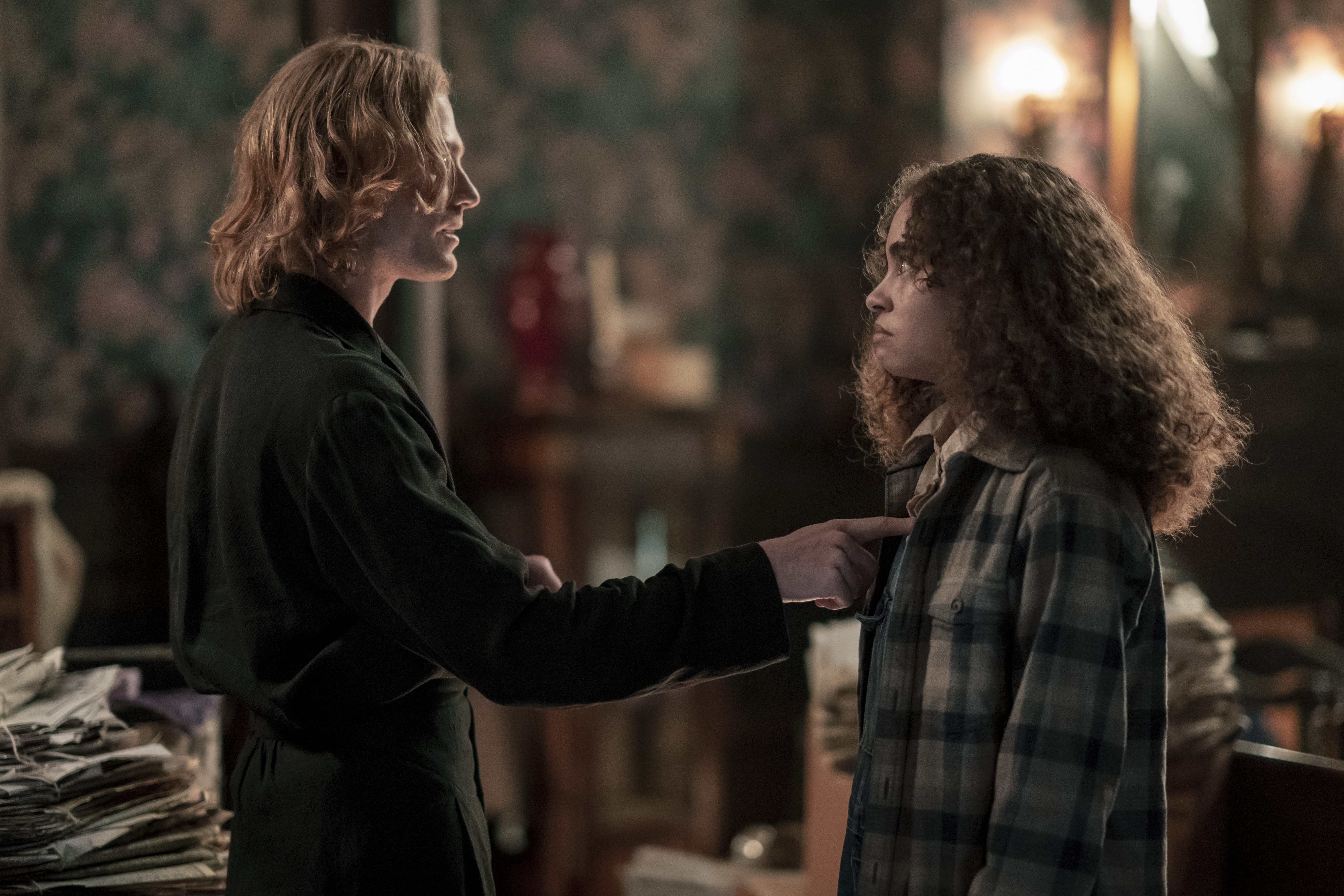
Sam Reid as Lestat de Lioncourt and Bailey Bass as Claudia. Photo Credit: Alfonso Bresciani/AMC
My companions in immortality
Our story comes to its ambitious, misguided head with a single word: Chéri. Colette’s novel follows an aging prostitute’s long affair with a vain, spoiled, fickle, domineering man. There’s a powerful attraction between them, though Léa denies it’s love for as long as she can, fearing Chéri will never return her feelings—and she is, unfortunately, correct. Chéri abandons his new wife for her, spends a passionate night with her, makes Léa admit he’s the “love of her life” and think they’re going to spend the rest of their lives together—only to waltz out of her home the next morning like an “escaped prisoner,” leaving Léa humiliated, heartbroken and alone.
The reference is a potential goldmine of insight into Louis’s insecurities with Lestat (especially once Lestat becomes unfaithful), though I think there’s another reason we open on this particular book title, and will soon hear it spoken for the first—and only—time.
Wherever Louis is in the book, he doesn’t get too far, as Claudia walks through their front door for the first time in seven years. Like magnets pulled together, she and Louis drift into an immediate, tender hug.
“Thank you,” Louis whispers. Tears of relief and disbelief well in Claudia’s eyes—
—Lestat, inevitably, and quite literally, ruins the moment, cutting the music with the flick of a stubby gray acrylic. “The prodigal daughter,” he croons from his perch at the record player.
As he tracks her movement with only his eyes, Claudia, surprisingly, offers an apology to them both. The years away from home weren’t easy on her, she can now admit; she knows she “put [them] both in a bad spot.” Luckily, she’s been cured by . . . her rape? Her head is “[back on],” and as we’ve seen nothing change in her life besides the encounter with Bruce—have barely seen her since the encounter with Bruce—that seems to be the implication. (It gives one of her next statements a potentially dark edge: “I realized I can’t live without Louis.”)
Louis is moved by the admission, but Lestat remains adamant in his belief that Claudia will never return to them. “Quick stop home to do laundry before you fuck off for good?”
For once, he’s a bit off the mark. Despite having followed them both, referring to them as her “companions,” whatever implications that statement may have, her tone changes instantaneously to match his. “A quick stop to pick up Louis,” she bites out. She intends to leave for Europe as soon as possible to search for the ancient vampires she’s been reading about; why, we don’t know, only she won’t be deterred by Lestat’s warnings that they’re “vicious.” The conversation takes its ugliest turn yet when Lestat, like a shark scenting blood in the water, latches on to an inkling she suffered some sort of attack while she was on her own.
“Read her, Louis,” he exults, and the writing, already poor, nosedives from here.
We’d copy the entire scene here were it not for length, because reading it on the page shows that it barely reads. Every other line is a leap in logic, topic and/or mood. It often feels like Claudia and Lestat are delivering two entirely separate monologues at Louis—which may be the intention, as each vies for his attention, but Lestat’s lines don’t make sense on their own, in relation to each other, or to anything Claudia is saying.
CLAUDIA: That’s it, keep ’em scared. That’s his way.
LESTAT: The vampires in Europe are much, much worse.
CLAUDIA: But I think he’s scared.
LESTAT: I never asked. How did Charlie taste? Like the love you’ll never really know?
CLAUDIA: And when he’s scared, he ridicules.
LESTAT: She was a destitute little girl, destined to live an inconsequential little life!
??? Where did the “destitute little girl” line come from? Why would he be saying it to Louis at that point in the conversation? “How did Charlie taste? Like the love you’ll never really know?” In dialogue and demeanor Lestat is like a wicked stepmother bot programmed to spit out preset responses, and that complaint is, like always, about execution more than anything else. Maybe the writers are trying to show an abuser lashing out the first time his victim pushes back, or a daughter who just learned how to break the cycle of abuse—to us, there’s no explanation that makes the writing itself good, or this an earned climax to the entire season when in this episode alone it’s impossible to chart Claudia’s journey with any sort of certainty.
The barbs continue to fly, but more important than wounding each other is winning Louis. Claudia swiftly pulls out her trump card: Come with me! she implores through their mind bond. His love is a small box he keeps you in! Don’t stay in it! Lestat loses whatever semblance of control he had left.
“A thousand nights of sulking,” he screams into the silence, “and at the first sight of her, you are just gonna up and leave me?!”
“Please,” bursts out of Claudia, “come with me! Let’s find”—be?—“vampires worthy of your love!”
Lestat lunges. Claudia finds herself once again pinned to a dresser, but this time Louis doesn’t look away.
Louis’s only concern through the ensuing onslaught is Claudia. “Stay back,” he pleads moments after being thrown into the front door. “It’s okay,” he wheezes as she traverses a broken, claw-marked staircase. “It’s all good,” he swears as she surveys their completely demolished second floor.
Claudia, for her part, throws herself onto Lestat to try to protect Louis, staggers up the stairs after him, gasps for the father she decided was brother one scene prior. She won’t be able to make it past the railing, as both have been easily overpowered by the much older and more powerful Lestat. Before the night is over he will drag Louis by a bloody flap in his throat, drop him out of the sky and, if they are keeping to the books, rape him by drinking from him without permission.
Louis will need another episode to come to terms with what Claudia, kneeling over his broken body, knows to be true: there is no turning back from this night. Lestat cannot change his monstrous nature, only ever hide it, and they are eternally unsafe so long as he lives and holds a century of power over them. He’ll prove over and over and over they have only one path leading to freedom, to happiness, them riding off into the sunset, the adventure of their lives—
—Louis fleeing Daniel’s questions, their miserable time in Europe, the “feeling that [Claudia] hated your guts there for a while,” Lestat’s murder, Louis’s own abuse of Claudia for Lestat. We’re as tired of repeating it as you are of reading it, but five minutes in the fandom will show the repetition is required. If you’re tracing back from a fake ending, what else falls away?
The contempt with which this post drips likely makes it clear that our answer for this episode is “a lot,” though we have no interest in speculating what may be revised or revealed or why. The writers can fall on their own sword. And we don’t argue there’s no fight; that has an almost negligible chance of happening. But the sequence is, technically and objectively, a mess, and if it’s not by design it is wildly inept.
• The aforementioned Chéri, I would argue, is our first signal something is off. It shouldn’t be a coincidence that we open and hold on a shot of this word when this scene is the only time Lestat will ever use it instead of “mon cher.” We’ll seem to get “Lou,” another endearment never to be spoken beyond this scene, a few minutes later.
• The director is careful to allow Claudia to witness, overall, maybe 30% of the fight. When it starts she’s on the ground catching her breath; by the time she gets up, Louis and Lestat have zoomed out of sight into the foyer. A dividing wall stands between it and the living room, flanked by a doorway on either side; Louis and Lestat go through the right one, while Claudia limps to the left. Once she reaches it, they leave the foyer to go back into the living room, and Claudia follows them the long way, limping along the dividing wall to the other doorway. When she finally reaches the living room to confront Lestat, she’s thrown to the ground, after which he and Louis zoom upstairs. It takes her twenty seconds to follow them; the entire second floor has already been destroyed by the time she arrives.
• Similarly, Louis and Lestat decide to stop fighting, and mysteriously start back up, offscreen.
• A chandelier crashes to the floor, and none of the neighbors notice. Two men physically demolish one of their walls, and none of the neighbors notice. Lestat drags Louis into the street and takes flight, and none of the neighbors notice. A body drops into their yard from 1,000 feet, and none of the neighbors notice.
• “I fought myself a million times,” Lestat booms as he drags Louis through the courtyard, “fought my nature, controlled my temper. I never once harmed you.” If they truly meant to suggest he was fighting some irrepressible vampire power from 1.01-1.04, they never showed it.
• We know from Claudia and Lestat’s car ride in 1.04 that vampires may be immortal, but they heal from injuries at a normal, slow human pace. When Louis lands in their yard, each one of his limbs is twisted at an angle indicating the bone has been broken, and he has bites and cuts in certain places. Some of these injuries will not be mentioned, or even in the same place, next episode.
• Speaking of continuity, Lestat enters the sky with lips bloodied from forcibly biting Louis, while he will float back to earth with a clean face and fresh blowout.
He could have wiped his mouth before descending, we admit. Maybe their neighbors are used to the strange goings on in their house and no longer bother to look over. Maybe a book is just a book.
Maybe the deliberately strange blocking and Claudia’s restricted POV were utilized not to reveal but explore the burden of proof placed on victims of abuse. As with her rape, what does an audience need to see to believe? So Lestat says the wrong nicknames—maybe he used them often, just never in any memories relevant to the story, so we never saw it. Maybe Claudia misremembered what he said; that’s allowed too. Victims often can’t recall everything that happened to them perfectly—nobody can, memory doesn’t work that way—yet it does not mean their stories are not true.
But this fact bears repeating as well: we’re watching a fake story within a fake story where a vampire with mind altering abilities is a major character. We don’t yet know for sure who is even in control of this story.
Ceding minutiae and acknowledging the myriad possible explanations as to why this scene—actually, episode—actually, season—were executed the way they were, we see three major sticking points if episode five is to stand as is:
• We have a direct comparison to another major Louis/Lestat fight in 1.03. We wrote then:
“That’s ’cause you took MY LIFE!” Louis screams back, past his breaking point. “I got nothing! I lost everything!” Brother and family and the “last fucking thing” he cares about, the Azalea, if he doesn’t think quick.
It’s intended to wound, and does. We’ve never seen Lestat look less human or out of control than he does during this fight, face ashen and black eyes streaked with bloody tears—and his response is, surprisingly, to shut down. He won’t do much more than sit in chilly, lofty indifference until Fenwick’s death.
For all intents and purposes Louis left Lestat at the end of the episode, and Lestat’s response was, basically, nothing. He retreated into himself. He didn’t attempt to stop Louis from leaving. He also started bleeding from the effort of telepathically sending a group of soldiers out of their house, yet is fine exerting what must be much greater power on his cloud gift now.
For whatever reason, the two fights have almost completely opposite outcomes. Maybe the comparison is there to hint that something’s off with 1.05; on the other hand, maybe it shows how much Lestat has devolved in two episodes, and/or how threatening he finds Louis and Claudia’s relationship.
• Fans often ask, what will it do to the show if they walk back any of this fight, the abuse Louis has suffered? They’d be showing a Black man and his daughter lying about their abuse at the hands of a white man. It’s a more than valid concern, and we can’t answer why the writers want to play with the theme of memory using such sensitive topics. But we see a flip side to this: if we were shown the truth in 1.05, why should we want Louis with Lestat, ever? What would the message be having a Black man forgive the white man who raped and nearly killed him? (It’s willful ignorance to pretend there’s any great chance they won’t be endgame. It’s what happens in Anne’s books and it’s what the cast and crew keeps advertising.)
What would Louis’s series-long arc be under these circumstances? Does it fit with what we’ve seen set up for him in the first four episodes? How can Lestat be “redeemed” from domestic violence (to, again, the point of dropping Louis from 1,000 feet and breaking each one of his limbs), entrapment (which is putting it nicely—Claudia will have a different term for it) and rape?
I don’t think any option here is great, and that’s on the writers.
• Claudia.
Fandom tends to discuss the potential of revisiting this memory, the possibility that anything involving Louis could be revised, as though it means the abuse will be “erased.” But even if they erased the entire 1.05 fight, from the living room to the drop, would it change anything about Claudia’s abuse? Even if all we’re left with is Lestat snarling at her she’s a broken bird, an anvil dragging them to the ocean floor, it’s abuse. Why would it matter less, or not at all, as often seems to be fandom’s implication?
There are other unresolved issues with Claudia. Her self harming from the end of 1.04 is dropped as of 1.05. She left New Orleans hating Louis and Lestat “both,” and we have no idea how she went from this to realizing she “can’t live” without Louis. In an episode powered by questionable artistic choices, she receives two of the most jarring—a recurring broken mirror.
The first example is in her bedroom, after Louis and Lestat read her diary and ambush her. “I’m never going to forget what happened here,” she swears. “I hate you both! Now get out of my room!” The mirror shatters. Only Claudia appears to notice; Louis and Lestat carry on like normal, but Claudia meets her cracked reflection, groans and collapses back into her coffin.
The second example takes place during the fight. Claudia limps upstairs and slumps against the railing. Holding her throat where Lestat—and later Louis—grab her, she once again meets her reflection in a broken mirror shard.
Mirror symbolism has a wide range of meanings, anything from wisdom and truth to vanity and illusion. It depends on story and context, so we likely won’t be able to fully interpret these mirrors until season two. They could indicate something general about the memories we’re seeing. Are they reflecting truth? The mirrors have shattered; what does that indicate?
Additionally or alternately, they may reveal something about Claudia herself. What we know now is that each mirror moment involves a family crisis ranging from, arguably, dysfunction to extreme domestic violence. Do the mirrors mean Claudia’s vision of her family, or the idea of them as a family, has been irrevocably destroyed? I’m not sure, as neither parent is ever included in the reflection. Is it something about the escalation of Lestat’s abuse? Again, I’m skeptical, because with the first mirror she screams she hates him and Louis “both.”
What is being reflected to Claudia is, literally, a broken image of herself, and whatever she sees leaves her not empowered but upset.
Related, or not, are a couple of incendiary statements from Daniel. He calls Claudia “Anne Frank mixed with Stephen King” and invokes Charles Manson when Louis tries to defend her: “Look, Charlie Manson wrote a couple of beautiful songs. Still, he was Charlie Manson.” The song choice for the end credits, rolling right after Claudia’s death stare at Lestat, is Manson’s “Home Is Where You’re Happy.”
Its selection means the writers find the comparison to Claudia meaningful or funny or both, and is a big part of why we question their much-lauded sensitivity and the outcome of episodes like this one.
Noteworthy
- We occasionally see people saying the “reveal” of the fight is going to be that it was actually somehow worse. Practically speaking what else can Lestat even do 😭
- Again, is Claudia still self harming???
- After Louis and Lestat read her 1917 and 1921 diaries, Claudia asks, “Did you read my other ones?” How many did she keep while she lived at Rue Royale? We’ll only ever see three from that period: these two and her special Lestat murder diary. Are there more we (and possibly Louis) haven’t seen?
- How did Claudia manage to store multiple decaying body parts in her room without either Louis or Lestat noticing the smell? They must have been there when Louis was leaving birds for her.
- Why are there so many empty wine bottles in the house during the Depression montage? We know vampires can get drunk feeding from inebriated victims, but consuming human food directly just tastes like chalk and paste to them.
- So what is the truth re: this current interview and book? The explanations change episode to episode. First Louis offered “truth and reconciliation” to Daniel, then announced the book “must be a warning [to humans] as much as anything.” In this session, Daniel gets “contextualizing Claudia” and “suicide chronicle,” courtesy of Armand. Does Louis really want to bait other vampires into killing him once his book is published, or is this conjecture from Armand?
 deep focus