

Trigger warnings: domestic violence.
A punctured lung. Blind in one eye for two months. Nightmares of falling—and then I would land all over again—even in Dubai, close to a century later. The recovery from Lestat’s attack is arduous, ongoing and greatly aided by Claudia.
She bars Lestat entry. She sits patiently for card games. She fetches meals and supervises as Louis learns to catch prey with a cane (“a few shattered vertebrae” are a stubborn problem, though the four broken limbs seem to have healed right up). She assumes his ostensibly vacated maid duties and oversees, presumably, the reconstruction of the second floor and collapsed chandelier, though there is no mention of this extensive reconstruction, and indoor shots are carefully tight at the beginning of the episode.
Daniel, strapped into the levodopa drip Louis and Armand have generously provided, has only one question about the aftermath of that harrowing night. “He could fly? Like Superman? . . . So for 20 years, you lived with the vampire Lestat, and you didn’t know he had the flying gift?”
Perhaps he recalls, as we immediately did, 1.01, in which Louis and Lestat levitate during sex. It would seem to imply Louis had some knowledge of this power over the years, yet he avers. “It was a remarkable bit of restraint he managed. I suppose he thought if he exposed all his power to me, I would never feel his equal and the relationship would suffer.”
Lestat is careful to remain on the ground throughout his efforts to win Louis—them—back. For six years there are thoughtful gifts, love bombing, manipulation subtle and not, all of which Claudia and Louis easily see through and reject. Unfortunately, a new plot point and bit of vampire lore is to prove too much to overcome. Lestat sends his most personal gift yet—a recording of Antoinette singing an original de Lioncourt composition—and a “vampire bond” is, apparently, triggered. Louis, as he explains in Dubai, had no choice but to storm over to Antoinette’s apartment, kick her out and top Lestat.
“But there were three of you,” Daniel replies, and we dissolve first to Antoinette, to reference the love triangle, and next to Claudia, to remind us that if a “vampire bond” existed, Claudia and Lestat would share one as well.
Do more
While we interpreted the dessert exchange in 1.02 as Daniel speaking to Louis’s self-hatred, another reading is him comforting Louis over Lestat’s abuse, demonstrating what a healthy relationship looks like. Instead of berating and pressuring Alice to be a certain way, as Lestat did to Louis, Daniel embraced Alice’s individuality. If that reading is correct, it’s strange that that sympathy has been spent by 1.06, as Louis not only spends years recovering from Lestat’s attack but is stalked and forced to accept his abuser back into his home.
Louis copes with this supernatural bond as best he can for as long as he can. If Lestat must return, there are to be rules and compromise for everyone; in what must be a time-saving edit, we miss the first three. The rest are as follows: kill Antoinette, pretend Claudia is their sister, no more lies. “If you can fly, tell us you can fly.” (A little later, we’ll watch as Louis and Lestat engage in their first levitating sex scene since 1.01. The placement of this scene, considering what we will continuously hear about Lestat’s secret cloud gift this episode, seems notable.)
To prove his honesty, Lestat launches into his backstory. To prove Antoinette’s death, he presents Claudia one rotting finger. To prove he’s changed, he offers free piano and chess lessons. Louis resumes drinking from humans the moment his family requests, a return of Lestat’s good faith efforts and an attempt to “lead by example,” though Claudia refuses to follow.
“One sob story about his birth,” she tsks, “and you’re back to eating from his hand.” A strange comment to make to someone suffering under a vampire bond, but Claudia is doing her own “enduring,” knowing “Lestat the vulnerable becomes Lestat the irritable becomes Lestat the controlling.”
“You’re ugly when you’re like this,” Louis replies. “Do more.”
Luckily, Claudia has been doing much more. She never stopped following Lestat, and after another charged, “joyless” chess lesson, drags Louis to the balcony of a garret a town away. Antoinette, one finger down, is inside.
She is abused by Lestat as he abuses his family, mostly Claudia. She is an “affected, self-absorbed, nasty little creature who’s fooled herself into thinking she’s smarter than she is.” Louis “broods” and allows their daughter to poison his mind. “I love you,” finishes his tirade. Claudia watches Louis grimly.
“I’m sorry,” she offers, maybe waiting for the supernatural bond to kick in once again. Yet though it drove him to passion earlier, though he is angry and hurt now—though he knows, as he openly admits, that Lestat is seeking another reaction from him—Louis sinks into a numbness even worse than when Claudia left.
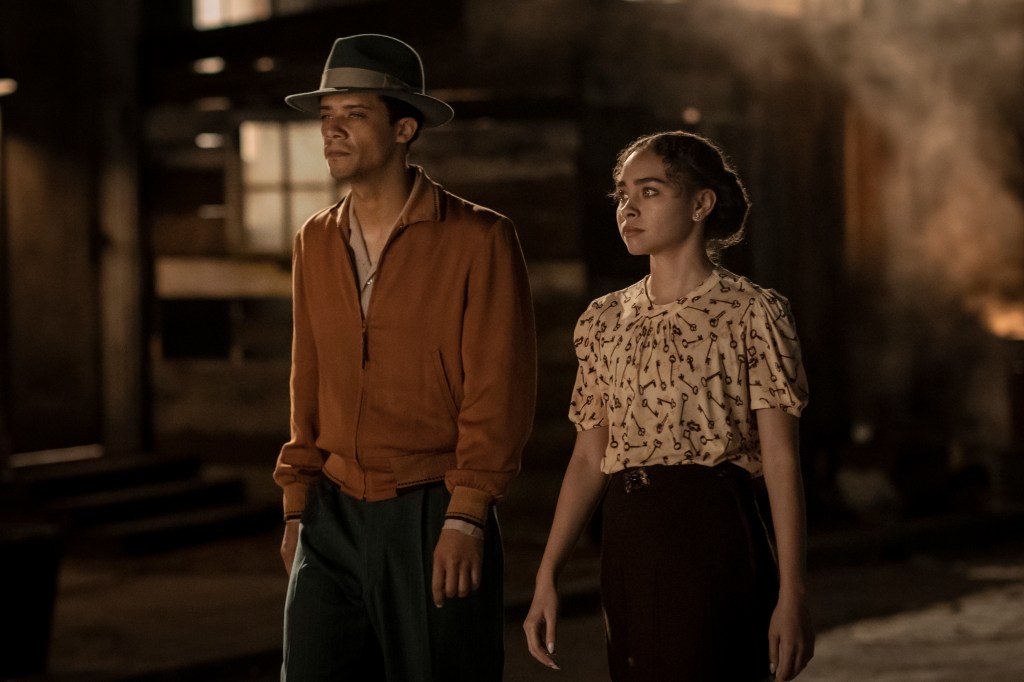
Visually the effect is overwhelming. Smart, stylish suits are replaced with the LL Bean fall catalog. Gold accessories, meant to impress, become oversized hats and belts for cinching baggy pants. The swordstick we haven’t seen since 1.01 reappears to serve as a walking aid, and an unspoken reminder of the constant fear in which Louis now lives. Verbally, his dialogue becomes about how useless and helpless he is. “I’d just hold you back.” “You don’t need me.” He can “barely speak French,” though we know he is fluent, and careful viewers will notice him reading La Nausée in the background of a scene. He frequently places himself in the background now, observing silently as Claudia and Lestat play tug of war over him.
Louis references another literary work that may provide insight into his mindset during this bleak period, Marriage in Free Society. Edward Carpenter’s essay dissects the state of marriage at the end of the 19th century, arguing it’s in need of an overhaul, primarily due to the grossly unequal status of half of the couple. Carpenter writes:
It will probably be felt that certain present difficulties in the marriage-relation are not merely casual or local, but are deeply intertwined with a long series of historical causes, which have led up to that exaggerated differentiation, and consequent misunderstanding, between the sexes. . . . Behind the relation of any individual man and woman to each other stands the historical age-evolved relation of the two sexes generally, spreading round and enclosing the former on all sides, and creating the social environment from which the individuals can hardly escape. Two young people in the present day may come together, but their relation is already largely determined by causes over which they have no control.
. . . In this state of confusion of mind, of mutual misunderstanding, and often of suffering, the Sex-glamor suddenly descends upon the two individuals and drives them into each other’s arms.
It may be said—and often of course is said—that such cases as these only prove that marriage was entered into under the influence of a passing glamor and delusion, and that there was not much real devotion to begin with. And no doubt there is truth enough in such remarks. But—we may say in reply—because two young people make a mistake in youth, to condemn them, for that reason, to lifelong suffering and mutual degradation, or to see them so condemned, without proposing any hope or way of deliverance, but with the one word “serves you right” on the lips, is a course which can commend itself only to the grimmest and dullest Calvinist.
It’s a dense text and a revealing choice, perhaps more so than Louis realizes. It will be interesting to revisit, depending on season two. For now, the intended takeaways are clear. Louis, on the long journey of recovery following his partner’s brutal attack, and as a Black man in an interracial relationship, can clearly relate to the “[relations] already largely determined by causes over which they have no control,” a “long series of historical causes, which have led up to . . . exaggerated differentiation.” Parallels to certain readings of his turning are obvious: “The civilised girl is led to the ‘altar;’ often in uttermost ignorance and misunderstanding as to the nature of the sacrificial rites about to be consummated.” Marriage can be “a death-struggle . . . in which either the oak must perish suffocated in the embraces of its partner, or in order to free the former into anything like healthy development the ivy must be sacrificed.”
Considering who makes another unwelcome appearance this episode, Carpenter’s views on monogamy are also of particular relevance. Carpenter identifies various ways to improve the state of marriage, one of which is to relax society’s understanding of monogamy. Love should be thought of as “freer, more companionable, and less pettily exclusive relationship;” and while Carpenter does not advocate for that having to entail infidelity, he does believe it’s simply part of human nature—especially for men—and will be easier to deal with if accepted as such.
It might not be so very difficult to get quite young people to understand this—to understand that even though they might have to contend with some superfluity of passion in early years, yet that the most permanent and most deeply-rooted desire within them will in all probability lead them at last to find their complete happiness and self-fulfilment only in a close union with a life-mate; and that towards this end they must be prepared to use self-control to prevent the aimless straying of their passions, and patience and tenderness towards the realisation of the union when its time comes. Probably most youths and girls, at the age of romance, would easily appreciate this position; and it would bring to them a much more effective and natural idea of the sacredness of Marriage than they ever get from the artificial thunder of the Church and the State on the subject.
Louis seems to take the words to heart. After his thunderous appearance in her apartment, he goes carefully blank on Antoinette. Any ire—and later vengeance—will come exclusively from Claudia.
The cliffs at Étretat
If Daddy Lou was already her favorite, Lestat’s attack has only caused Claudia to grow more “protective,” as Louis puts it. As he fades away to the “housewife” she always knew him to be, the bride Carpenter describes, essentially dropping out of his own narrative an episode before the finale, his new sister is ready.
Early in the episode, Louis proclaims himself Claudia’s “knight,” yet it often feels like the roles are reversed. With the gift of “sensing trouble from a mile away,” Claudia is prepared, it seems, for every possibility. A sophisticated understanding of abuse stymies Lestat’s constant efforts to erase his attack. She seems to possess a preternatural understanding of Louis as well, knowing things about himself before he can even admit them to himself, and has since she first deemed him housewife. Treats you like shit and you take it, she told him then. Now, she sends commiserating images of Bruce, and escape routes, as Louis endures (to use a motif from this episode) sex with Lestat. You will enjoy killing him closes the episode.
Throughout the last two acts of the season, Louis will take great, if unsubtle, care to ensure Claudia gets her due credit for saving his life. “It was a masterful month of preparation.” “Claudia used our advantage sparingly.” “Make no mistake, Claudia was plotting, quiet in her deer blind.” “There were plans to make, but the architect of those plans was—”
“Claudia,” Daniel will interrupt, wearily. “Right. Cold, calculating, on a mission.”
Yet beneath the lavish praise and heavy hand remain hints of darkness and an obsession with vampire lore. During their household meeting she presses Lestat for that lore, infuriated when he claims to know nothing. She shows particular interest in flying, refusing to accept it’s not a teachable skill. She’s been learning Romanian in her spare time, so it seems her plans to leave have not been fully abandoned.
We’re left with the same unresolved issues from 1.05. Why did she cancel her travel plans, far beyond Louis’s recovery? How did she go from hating Louis to dropping her entire life to devote herself to his care?
Why is she still following Lestat? It’s treated almost as background noise, yet it’s major, ongoing action that involves, and may offer insight into, two main characters.
The first spying period, ongoing as of the start of 1.05, finds Claudia in crisis to the point of self harming. Her loneliness, especially upon witnessing Louis and Lestat’s bond, has become crippling and consuming. She is desperate for her own vampire companion, which may play a part in why she begins following Lestat. Yet whatever she may have sought at first, she learns something else instead: he’s having an affair with Antoinette. This seems to be what she primarily witnesses as she continues to follow him.
The second spying period occurs after leaving college. She followed both Louis and Lestat, her “companions in darkness.” It seems to bring her closer to Louis, as she watches Grace “abandon” him and decides to fill that sudden void (and take him with her to Europe), but it is unknown what she witnessed with Lestat. At home she offers both parents an apology, yet immediately switches tacks when Lestat is unreceptive.
And when she brings Louis to Antoinette’s apartment in 1.06, she is the target of Lestat’s rage. “Self-absorbed,” he rants, “nasty,” stupid. “I have given her gifts, so many incalculable gifts. . . .” At this time, Claudia is also preoccupied with learning how to fly.
Each period seems to involve, first, some type of supernatural need. Before college, Claudia was trying to turn her own companion. After college, she is seeking a travel companion (and has also been poring over vampire lore, pleading with Lestat to tell her the truth). In this episode she’s determined to fly. We can posit, therefore, that her spying involves learning vampire secrets, especially when she’s convinced Lestat is lying to her about everything.
Another, more personal pattern emerges, this one involving Lestat, his role in the family and what, to Claudia, must seem like his hatred for her. Louis’s narration paints her as unaffected, at least after 1.05, but if we put ourselves in Claudia’s shoes: how would it feel to be a young woman discovering your father’s affair for the first time? Hearing him hurl abuse about you to his mistress, over the course of decades? Witnessing him confirm, over and over, that he doesn’t like or want you? Behavior like Lestat’s would be a blow to even the strongest person, one that would be hard to shake, no matter the relationship with the brother uncle father in question.
What would make you keep seeking it out?
Claudia may develop other reasons for spying—seeking lore, protecting Louis—but we wonder if there isn’t something messy, ugly, almost masochistic, like she can’t look away, at the core.
Her Antoinette obsession strikes us the same way. It is Claudia who pushes for Antoinette’s death, Claudia who wears her ring like a trophy, Claudia who insults her: “flat, no-nothing ass,” “desperate trash.” The usual litany of explanations are available: perhaps Claudia is once again speaking for her beloved brother, expressing all the rage and disgust his depression won’t allow. Perhaps, as Antoinette is a grown woman, the obsession centers around Claudia’s inability to grow up. Perhaps it’s that Lestat seems to choose Antoinette over her and Louis. But something about it seems to bother Claudia on a very deep level, and it’s a bit jarring when Lestat’s partner, following his mad dash up the Mississippi, barely even mentions her name.
My belladonic beauty
Does the previous section mean Claudia has any remnant feeling for Lestat? Daniel will scoff at the idea, and in the books it’s revealed she hated Louis and Lestat both for what they did to her. We don’t expect a lot of that to change; we just think she may be much more wounded by Lestat’s treatment than the interview would like to admit, and that could potentially have a huge impact on the show. We think Lestat’s feelings for Claudia warrant a closer look for the same reasons.
His abuse of Claudia is inarguable and, as we just said, unlikely to change. Their chess games alone are proof enough, less lessons than excuses to taunt Claudia, call her stupid, criticize her every move. “You didn’t want me,” Claudia weeps. “You made me for Louis.”
Yet there are also many examples of Lestat’s affection for her. He gifts her a necklace “given to me by a marquis,” meaning, based on his book background, there’s a possibility it’s a family heirloom. He, with Louis, buys her outfits (“I don’t recall buying that outfit”). During their driving lesson, he tugs her hair and calls her his “belladonic beauty.” He recognizes her hunting prowess, wants to encourage it and intends to spend the time teaching her.
Are these actions not merely further examples of the same “love” that stalked Louis at his brother’s funeral, destroyed what is euphemistically referred to as a support system and cornered Louis into turning? Very possibly, but there are other interesting layers to Claudia and Lestat’s relationship we think season one may be hinting at. There may be hints, for example, that this perceived rejection goes both ways—“Daddy Lou” versus “Uncle Les,” with Claudia and Louis’s telepathic bond a particular sore spot for Lestat since the start. The second interview repeatedly remarks upon how similar Lestat and Claudia are, through words and arguably imagery, if you put stock into stuff like both of them waiting for their crushes on their balcony.
More than that, there are alternate readings available (not definitive, merely available) for each time Lestat is portrayed as uncaring toward Claudia. It’s not a discussion worth having until season two, but take, for example, when Louis confronts Lestat at his piano in 1.05. There’s a clear juxtaposition between Lestat tinkering at his piano as Louis frets for Claudia’s safety, yet their dialogue reveals something else.
LESTAT: I know what I’d do. But my parenting is—
LOUIS: Sadistic. She’s in there ’cause of you!
Lestat never actually handles anything well, so we are not saying Louis should have listened to “what [he’d] do.” But there is an interest in helping Claudia, and the accusation that he caused her breakdown stings. It’s what drags Lestat away from his piano as he goes to prove that Claudia is, as he said, out hunting—which we feel is another important aspect to their relationship. As we’ve mentioned before, Lestat and Daniel are, so far, usually right about matters concerning Claudia’s nature. “She’s starving in her coffin” versus “She’s out hunting” is the most obvious example, with 1.06 potentially adding a few more.
The first occurs soon after Lestat is allowed back home, the conversation where Louis ascribes Claudia’s behavior to protectiveness. Lestat arrives at a much graver conclusion: “There’s been a darkness to her since she returned to us.” It will be interesting to see if this statement holds any water.
The second regards Claudia’s updated family status. “It’s not as simple as choosing a new family configuration,” Lestat protests; rightly, we feel, and as Louis’s continued, exclusive use of “daughter” in Dubai would seem to confirm.
To explore this, it’s worth putting ourselves in a parent’s shoes. Parenting entails significant responsibility and commitment; chief among a parent’s obligations to their child—what a child is, ideally, entitled to—are protection, care and unconditional love. Unlike other family bonds that may vary in intensity or duration, the parent-child relationship is supposed to be enduring and lifelong.
What would it signify, then, if a parent didn’t protest losing that special title, what’s supposed to be their special place in their child’s life? (Might Claudia have wanted them to protest?) How should one react to their child expressing the desire to be siblings instead—especially when, last you knew, the child was experiencing a breakdown? It’s a bizarre, alarming request, frankly, one that conveys Claudia’s deep unhappiness within the family, and it’s extremely telling how neither father puts up much of a protest, tries to address any underlying issues or reassure her of her status as their cherished daughter.
Switching to Claudia’s perspective, how might it feel to see your parents almost immediately relinquish what’s supposed to be their special role in your life, and yours in theirs, on top of the isolation and turmoil you’re already experiencing? What does it say that she desires the shift at all; what is the difference between father-daughter and brother-sister? Everything, essentially, especially in terms of hierarchy and caretaking/emotional obligations, and we think that may be key.
We know that on his best behavior Lestat struggles to express love for Claudia, and abuses her at his worst. Depending on who came up with “Uncle Les,” he may have openly refused to claim a parental role in her life. We know that Claudia feels, at best, excluded from the Louis&Lestat unit (“Who’s my Lestat? Who’s my Louis?”), but her subsequent breakdown shows it goes far deeper than that. The fact that at the end of 1.05 she says she’s been “pondering” the reason Louis and Lestat turned her “for a decade” is in and of itself an alarm bell. If she’s wondering why they ever had her, she feels profoundly lost and unwanted.
While many fans find sister Claudia an act of freedom and autonomy, we think it may hint at much deeper issues. Claudia may feel forcing the three of them into a sibling dynamic will lessen the pain of her current existence, and also provide her more equality and power in a household in which she’s felt decidedly powerless.
If this is the case, she’s likely to run into problems. If they follow the books Lestat’s relationship with his brothers was abysmal, while show Louis, acting as head of the de Pointe du Lac household, was never “equals” with his younger siblings. He’s not likely to have sought such a relationship with any replacement sibling, if that was why he turned Claudia, which it wasn’t. Whatever his limitations as a parent, he was delighted to have a daughter and never stopped thinking of her that way.
(And we’re curious to see if this will become an issue for sister Claudia: Paul, and not Grace, was Louis’s favorite sibling. “I loved him more than anyone on earth,” as he says in the pilot.)
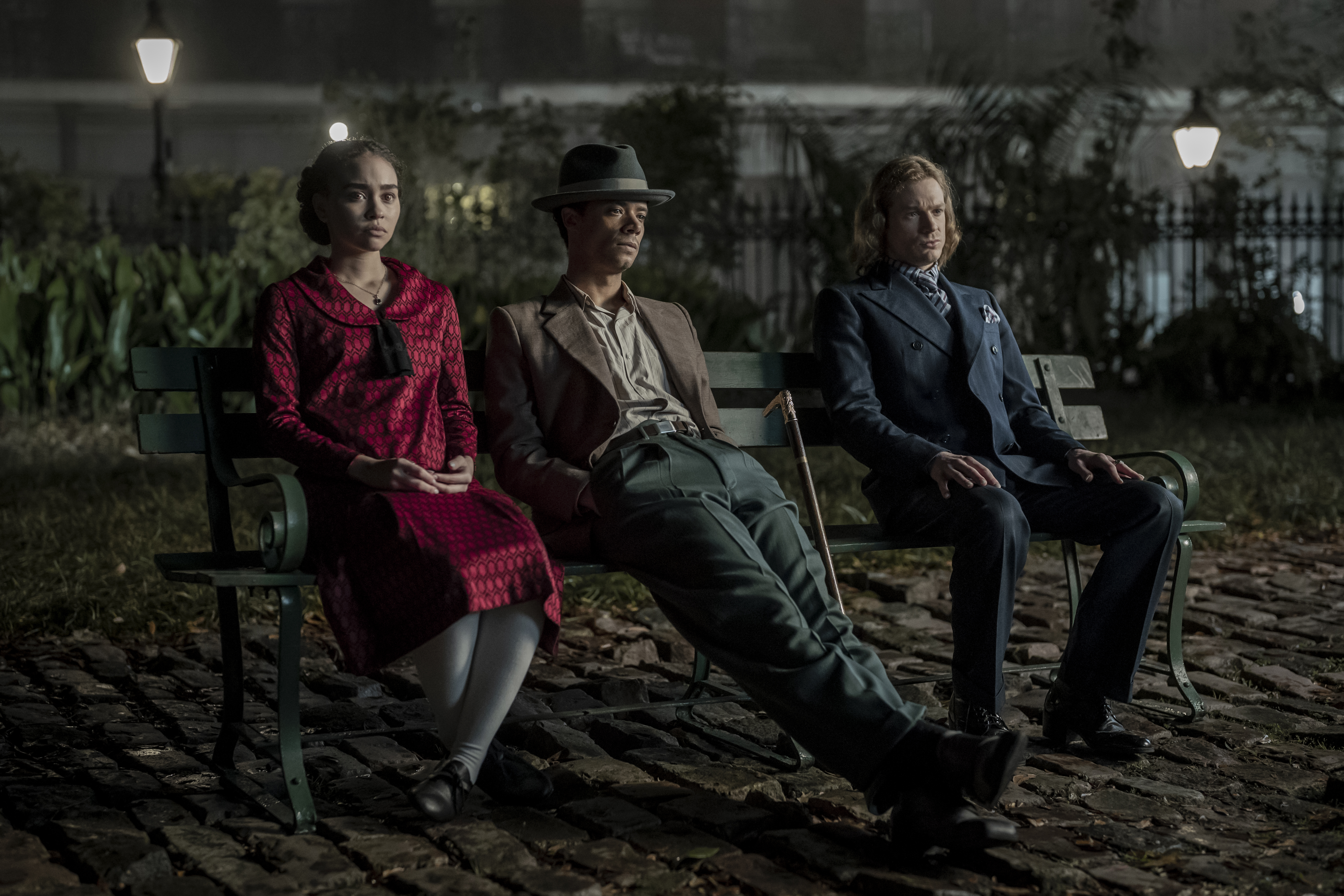
Bailey Bass as Claudia, Jacob Anderson as Louis de Pointe du Lac and Sam Reid as Lestat de Lioncourt. Photo Credit: Alfonso Bresciani/AMC
A vessel of acceptance
None of the above discussion would change or excuse any of Lestat’s behavior toward Claudia. He’d be absolved of nothing if his feelings for her were slightly more complex than blinding hatred. But it could change certain events moving forward—like his role in her murder in Paris—and ones the cast and crew have said they plan to revisit, like the finale, where we’ll watch Lestat concoct a plan to kill and replace his daughter with Antoinette.
Louis keeps building to that finale. The bench that went from deep conversations to stilted small talk finally finds the family sitting in silence, going their separate ways. Physically and mentally Louis is a “vessel of acceptance,” a “dissociative shell” unable to share Claudia’s dreams of escape. Lestat’s attack triggered a new phase of his existential crisis, perhaps the worst one yet: “Every night, I feel a little crazier. Give us a hundred more years of this, taking anything we want, killing anything in front of us, no one says shit about it; I can see us just like him. I can see it, Claudia.”
(Though the aftermath of Lestat’s attack leaves little room to explore some of Louis’s ongoing personal issues, like his abrupt return to eating humans, we also note that if we are correct about our “projects” theory, Louis has lost his last one, his daughter. There is nothing left to tie him to his former, human life or self.)
While 1.05 plunges Louis into depression, it’s had the opposite effect on Claudia. The girl who reveled in vampirism from the moment she turned, laughed at being called a devil, kept souvenirs from her victims to the point of disgusting even Lestat, the girl for whom “all humans died with Charlie,” the girl whose father mentions how alike she is to Lestat this very episode, now leaps off the bench to proclaim she could never imagine being Lestat. “Come with me!” she pleads to Louis.
But whatever kept Louis in the townhouse for six years after Lestat’s attack—to the supernatural bond? he adds that sudden poor command of English and French—keeps Louis from joining her. He’d only hold her back, he laments, bumbling through the name of a Romanian town as proof before giving her his blessing to leave.
As Claudia races off to freedom, Louis contemplates suicide. Thoughts of how Paul ruined Grace’s wedding compel him back to the house he’s been unable to leave for six years, only to find he needn’t have worried. Somebody else has filled Paul’s role.
Five moves ahead
Louis is not pulling from a diary, and Claudia has been loath to share her dark memories with Louis as recently as earlier this episode, but it seems she made an exception for this one.
On the train, Claudia is overjoyed to finally be free, even if she’s forced to “make do” with a hiding spot in the storage car—until she hears a noise. We already know who will come prancing through the car door.
There is a ventriloquist skit with a severed head. There are taunts her about her rape and threats to grind her bones into dust. There is a caged animal, in case this scene was too subtle, and Claudia weeping into her hands as Lestat readies to drag her back home. Once there he is smug as ever, flushed with triumph at what only seems to be Claudia and Louis’s total submission. As Louis observes in the background, Claudia endures another humiliating chess game—until, in moves that surprise him and Lestat both, she executes a successful replica of Miguel Najdorf’s Polish Immortal game, locking Lestat in check and the throes of a tantrum.
She doesn’t bother to claim her victory; there’s a much bigger one in sight. The key, she conveys to Louis, is “to think like he does and then five moves ahead of that,” and it’s going to help her secure the ultimate prize of their freedom.
It’s a prize Lestat has made painfully clear can only be won one way. Claudia had admitted defeat, and Lestat could not allow it. She’d taken nothing that actually mattered to him, only herself, and he could not allow it. He had what he wanted, Louis, and he could not allow it. With him the cruelty is the point, and it will stop only with his death.
Ironically, that cruelty, that vindictive, egotistical, insatiable need to dominate, will be Claudia’s greatest weapon in the finale. She may be no match for Lestat’s physical power, but one insulting word from Tom Anderson—a barely perceptible shift in Lestat’s body language in response—and she knows exactly whom to target with her poison. “Always the petty slights with you, Uncle Les!”
Even after everything Lestat has done to her and Louis, even knowing he forced her into this corner, Claudia will struggle to deliver the final, irrevocable blow. “I’ve killed so many,” she’ll murmur over his almost lifeless body. “Just . . . no one I. . . .”
Though she won’t be able to burn him—
“She stuck a pen in his neck,” Daniel will counter. “She recorded his last words in his own blood. The girl did not have a fucking problem tossing him on the grill, okay?”
—she and Louis will manage to rally. They will incinerate Antoinette and dump Lestat in the trash where he belongs. They will head, hand in hand, toward “a merchant vessel, newly christened and headed for Europe” and “the adventure of [their] lives.” It’s a joyous ending, one every viewer should celebrate after the harrowing tale we’ve just watched.
“Well,” will be Daniel’s pronouncement. “Isn’t that neat and tidy?”
“There was a ship,” Louis will reply, warily. “We did get on it.”
Likewise, Louis ended his original interview with Claudia boarding a train, so we know Claudia did attempt to leave and Lestat brought her back. An episode prior we said the chances of no fight taking place are negligible. Our general view is, if there is any altering going on, scenes are not being made up whole cloth, i.e. if we see them at the opera, something happened at the opera.*
So if we think the building blocks will remain the same—if all the general plot elements continue to exist—how substantially could the story be altered?
As we said in 1.05, we don’t want to speculate. These are ugly topics to speculate about (and, we anticipate, to have built a show around). We also acknowledge, at every point of contention, the many alternate explanations available. Perhaps the point will be that we questioned anything at all.
But the element we feel is missing from every other explanation is the one we think is most crucial: we’re watching a story within a story, which changes how the show must be examined. Within that framework, Louis is not our omniscient narrator and what unfolds in his interview is not the main narrative. Within that framework, the main narrative would be figuring out what’s wrong with the interview, and why—as is Daniel’s stated goal, and something Louis seems to encourage.
DANIEL: I ask all the wrong questions.
LOUIS: Yes.
DANIEL: There’s contradictions in your story I never follow up on.
LOUIS: Yes.
DANIEL: The few good ones I do manage to get out, you steamroll over them. It’s not an interview. It’s a fever dream told to an idiot.
LOUIS: Yes. . . . I, too, find the tapes lacking.
Within that framework, and only that framework, Louis’s motivations matter. Armand’s motivations likely matter. Daniel’s reactions, especially given his background, matter. He’s an expert in writing, journalism and storytelling, and he’s met this story within a story’s second act—the one that makes Lestat’s villainy inarguable, his murder unavoidable—with boredom and scorn. “We were going to kill Lestat,” Louis announces, the logical, worthy conclusion of rape, domestic abuse, stalking, entrapment, “misery with no horizon,” and Daniel has fallen asleep.
*The only one that gives us pause is the drop, solely because it’s such a famous Armand/Lestat scene from the books. It seems strange to repeat it. Maybe it’s been reassigned.
[Armand] leaned forward, and his face transformed itself as it had done years and years ago, as if his rage were melting it from within. . . . And his voice shot out of him like the tongue of a snake.
. . . In a dark flash his hand went out, and my head went back, and I saw the sky and the city of Paris upside down.
I was falling through the air. And I went down and down past the windows of the tower, until the stone walkway rose up to catch me, and every bone in my body broke within its thin case of preternatural skin.
The Vampire Lestat, Anne Rice

